 Szlak Jelonków
Jelenia Góra Town Trail · the long route · extra point · Cieplice
Grunwald Swords on ul. Cervi
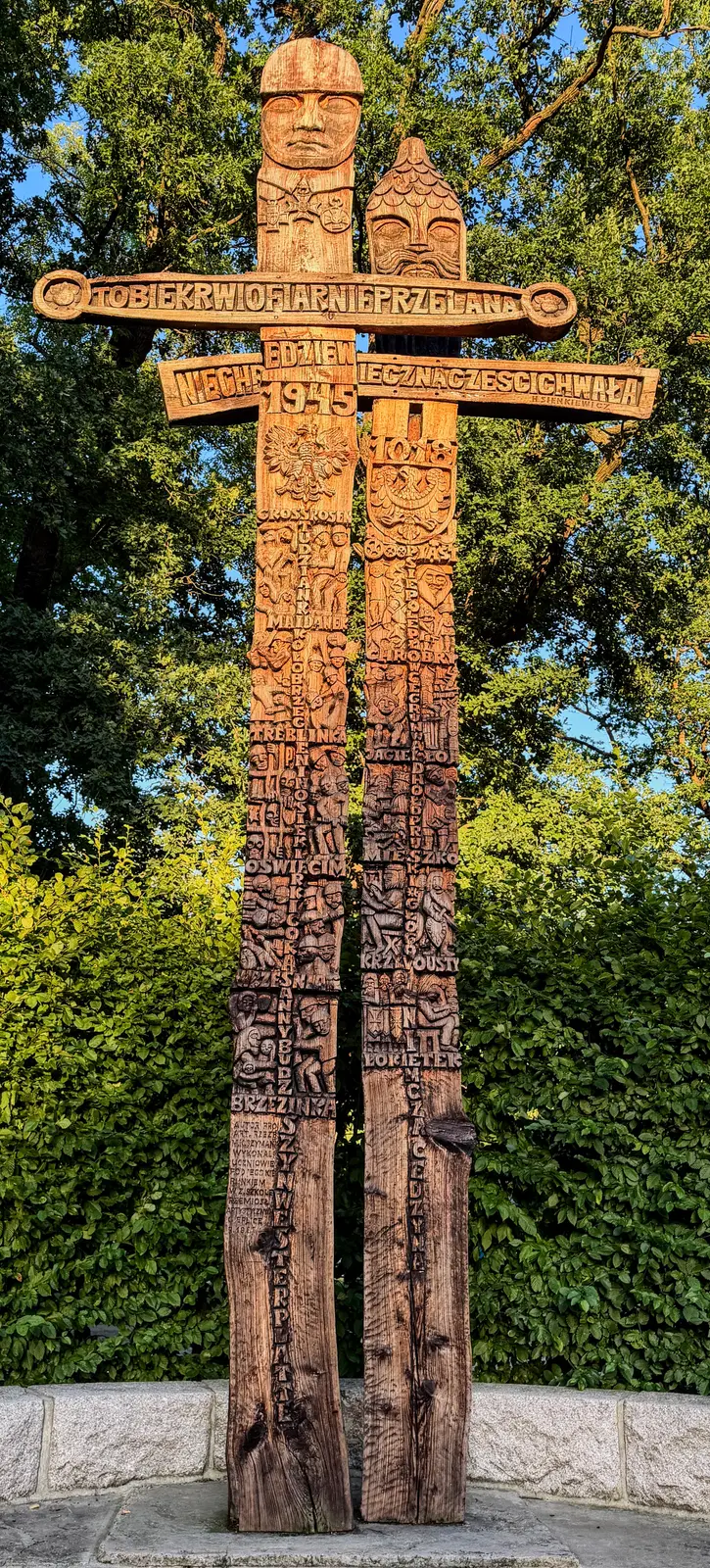
This little square on ul. Cervi looks ordinary: three steps, a granite wall, two wooden swords. In fact three different monuments have stood here in turn, and each one used what the previous one left behind. Today's swords of 1967 stand on the plinth of a German memorial to the fallen of the First World War – and that is the most interesting thing about the place.
The name everybody uses is the colloquial one. Officially this is the Monument to the Martyrdom and Glory of Polish Arms, and the sculptures themselves appear in city documents as the Piast Swords – “Grunwald” describes their styling, not their name.
A weeping woman and plaques with names
Between the wars, around 1925, the authorities of Warmbrunn raised a monument here to the townspeople who had died at the fronts of the First World War. It looked different from what most people imagine when they hear “war memorial”: instead of a victorious figure – a sculpture of a weeping woman, set centrally on the wall facing the park.
On either side stood granite walls topped with helmets, carrying plaques with the names of the fallen. Three steps led up to the monument – the same ones you climb today.
The design was by Cirillo dell'Antonio, a sculptor and teacher at the Cieplice School of Woodcarving. That name will return in this story, in a way nobody could have invented.
Removed right after the war
The monument survived the war. It did not survive what came after: as soon as fighting ended it was swiftly removed, with the participation of Soviet soldiers. The steps and the wall remained, and the place grew over with shrubs.
That was neither an accident nor a local decision. The removal of German war memorials from the lands taken over by Poland was a mass phenomenon and has its own scholarly literature. What is different in Cieplice is that the plinth stayed and immediately found a new tenant.
A Mickiewicz of newspaper and clay
In the 1950s the empty spot was taken on by Jan Serafin, a sculptor from Otynia near Stanisławów, who from 1946 lived – and here the coincidence turns literary – in the house that had belonged to Cirillo dell'Antonio. Together with his sons Bogusław and Eugeniusz he put up on the wall, where the weeping woman had been, a monument to Adam Mickiewicz. Built of newspaper and clay.
The result pleased nobody: not the authorities, not the residents, not the press. In an age when socialist realism ruled in art, Serafin's national bard was too avant-garde and “too Western”. The newspapers wrote about it as something that disfigured the town. The sculpture was eventually removed and the square stood empty again.
Swords for the millennium
The third attempt worked and still stands. As the celebrations of the millennium of the Polish state approached, teachers at the School of Artistic Crafts proposed a new monument. It was made by Marian Szymanik with his pupils, in two and a half months, in 1967. The unveiling took place on 14 October 1967.
The material was larch wood – from an eighty-year-old larch felled on the school grounds. The press gives a height of seven metres.
The form is two stylised swords driven into the ground. It points two ways at once: to Jan Długosz's account of the battle of Grunwald, where envoys bring the king two bare swords, and to the Cross of Grunwald – a decoration of the Second World War. The pommels are heads: a warrior and a soldier – according to the press, a modern soldier on the right and a warrior from the times of Bolesław Krzywousty on the left.
What is written on them
A two-line inscription runs along the crossguards, legible from the pavement: “TOBIE KRWI OFIARNIE PRZELANA NIECHAJ BĘDZIE WIECZNA CZEŚĆ I CHWAŁA” – to you, blood shed in sacrifice, may there be eternal honour and glory – and beneath it, in smaller letters, a signature: H. Sienkiewicz.
The blades are two separate stories, and each has its date carved just below the crossguard.
The sword dated 1018 carries Piast history: beneath an eagle run PIAST, CHROBRY, MIESZKO, KRZYWOUSTY, ŁOKIETEK, CEDYNIA and further names and battles, interleaved with reliefs.
The sword dated 1945 is the martyrology: GROSS-ROSEN, MAJDANEK, TREBLINKA, OŚWIĘCIM, BRZEZINKA, KOŁOBRZEG, WESTERPLATTE. The year 1018 and the year 1945 on two neighbouring blades are the span this monument covers: from the time of Bolesław Chrobry to the end of the Second World War.
At the foot of the left blade there is something no description mentions – the monument signs itself: “AUTOR PROJ. ART. RZEŹB. M. K. SZYMANIK, WYKONALI UCZNIOWIE POD JEGO KIERUNKIEM W Z. SZKOLE RZEMIOSŁ ARTYSTYCZNYCH CIEPLICE, R. 196…” – designed by the sculptor M. K. Szymanik, made by pupils under his direction at the School of Artistic Crafts in Cieplice.
That settles the spelling of the author's name: heritage records sometimes give “Szymanek”, but the wood plainly reads SZYMANIK. Only the last digit of the year is illegible – the plank is weathered there and a knot runs through it. Everything else points to 1967, the year given in descriptions of the monument.
The plinth they stand on was restored in August 2024 by the municipal utility company – on the same occasion the sculpture of Karkonosz on the square next door was renovated.
One school, three monuments and the little deer
The most interesting thing here is what you cannot see: all three monuments were made by people from one school.
Cirillo dell'Antonio, author of the first, came here from Italy. He was born on 27 October 1876 in Moena in Trentino, learned his craft in his father's forge and sculpture from 1892 in Val Gardena. From 1903 he taught at the Cieplice School of Woodcarving, and from 1922 he was its director. He carved in wood and stone, cast in metal, made medals. He died in 1971 in Trier.
The School of Woodcarving worked in Cieplice from 1902 to 1945. After the war the State School of the Timber Industry started in the same building – the first classes on 27 September 1946 – and from it descends today's School of Artistic Crafts.
So the swords of 1967 were made by a teacher and pupils of the same school that forty years earlier had produced the author of the war memorial. And today the pupils of that school carve the little deer – the same ones you will find in the list of the deer and all over the city. One institution, three eras and four generations of craftsmen in one place.
Why two swords
The form of the monument is not decorative but a quotation – a double one.
The first lead goes to Jan Długosz. In his account of the battle of Grunwald the Teutonic envoys bring the king two bare swords, at once an encouragement to fight and a mockery. The scene entered the canon of Polish historical imagination so firmly that the image of two swords alone is enough for everyone to know what is meant, with no caption.
The second lead is closer to the time the monument was made: the Cross of Grunwald, a decoration established during the Second World War. Two crossed swords were its hallmark.
The 1967 monument therefore joins one to the other: a medieval victory and a wartime decoration, in the year of the millennium celebrations. That is a very specific language of its era – which is why it is worth reading as a document of that time, not only as a sculpture.
A deer across the street
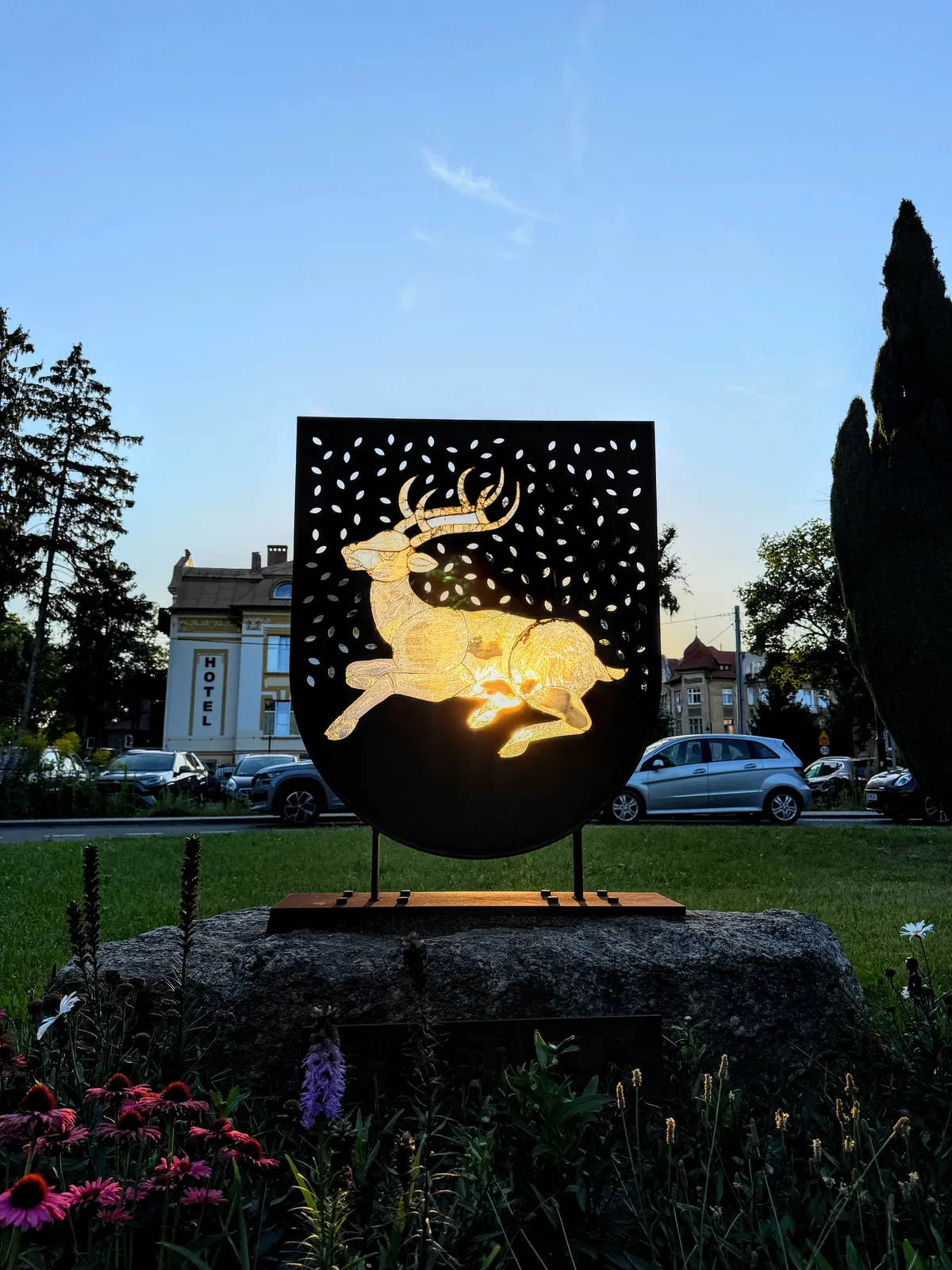
Opposite the swords, on the other side of the street, stands a deer with the inscription CERVIA and the dates 1976–2016. It is not an ornament but an explanation of the street name – and one of the few things in the city that connect with the little deer literally, not just by theme.
Cervia is an Italian town in the province of Ravenna, a partner of Jelenia Góra. The cooperation agreement was signed on 2 April 1976 and renewed on 8 October 1999. The towns exchanged street names: here there is ul. Cervi, and in Cervia a via Jelenia Gora.
Note the spelling, because it is the commonest misunderstanding here: the street is called Cervi, with one “i”, while the town is Cervia. On the monument beneath the deer stands the full Italian name: CERVIA. The shortened form in the street name looks like a surname – and is indeed sometimes taken for the name of the Italian Cervi brothers, with whom it has nothing to do.
The reason for this friendship is heraldic: there is a stag in the arms of Cervia, just as in the arms of Jelenia Góra. The city hall writes plainly about the “shared element of the coats of arms” of the two towns.
The name itself is more interesting than the popular version suggests. Italian sources give three leads: the legend of a stag that knelt before the bishop of Lodi and found its way into the arms; the Latin acervi, “heaps” – from the mounds of salt whitening above the old town; and the cult of the goddess Ceres. The first version is the most popular, but researchers point rather to salt.
And here the pairing of the towns turns out even better chosen: Cervia is a town of salt and a spa, Cieplice a spa on hot springs. Two resorts, two stags in the arms and street names exchanged.
The monument was unveiled for the fortieth anniversary of the partnership in 2016, and its author, according to the press, is Mirosław Kulka of the Jelenia Góra Culture Centre. In the same year a square answering this one was laid out in Cervia.
Beside it stands a board – by now so faded that the text has to be read against the light – carrying the same sentence in Polish, Italian and English. It is worth knowing, because it explains why the stag stands here: “The deer, which is a symbol in coats of arms of both towns, commemorate this event. It will remind of the need to cultivate traditions and values, which will help to better understand culture and history of both cities.” The heading reads 40 LAT PARTNERSTWA MIAST (1976–2016), with the arms of Jelenia Góra on one side and of the commune of Cervia on the other.
Note the wording: the board speaks of the deer as a symbol from the arms of both towns, not as a copy of the Italian one.
Contrary to first impressions this is not a sculpture of a deer but a heraldic shield of Corten steel – rusted – holding a stag of glass, matt and translucent. The ground of the shield is perforated into leaf shapes, so the grass shows through it. Below stands the inscription CERVIA.
The combination of materials is the whole content here: rust and glass, heavy and fragile, matt and translucent. In sunshine the glass stag catches the light; on a cloudy day it turns as grey as the steel around it.
The monument alludes to the arms of Cervia but is not a copy of them – and it is worth knowing exactly what was taken. The blazon reads: *“azure, a stag couchant or on grass proper”*. The pose of the animal matches: the stag lies down, exactly as in the arms. The rest is the artist's own composition – instead of grassy ground, perforation in leaf shapes; instead of azure and gold, rust and glass; the shape of the shield is different too.
It is worth comparing the two coats of arms, because both have a stag and they are easy to confuse. The arms of Jelenia Góra show a red stag standing on three green hills, with three golden acorns in its mouth. The Cervia one is golden and couchant, on grass. What they share is the animal, not the composition – and it is that animal the friendship of the two towns rests on.
A note for those collecting the little deer: this stag is not part of the Deer Trail. It is a separate sculpture with a different origin and a different function – but it stands so close to the swords that it is worth knowing what you are looking at.
What you can see today
Standing in front of the monument, you are looking at two different eras at once, and most people do not notice.
The concrete base, the granite slabs forming the three steps and the wall on the park side date from the interwar years – what remains of dell'Antonio's monument. Heritage catalogues say so plainly: today's monument “stands on the site of the former war memorial (the steps and the stone plinth preserved)”. The wooden swords are from 1967. Between the two there was also the Mickiewicz, of which nothing remains.
It is worth stepping closer to look at the inscriptions on the crossguards and blades and at the heads on the hilts – from a distance they look like ornamental knobs, close up they are two faces from two different centuries.
This is also the place where all the more important state ceremonies in Cieplice are held. The plinth that started as a German war memorial has served that role without a break for a hundred years – only what stands on it has changed.
Where it is
The square lies on ul. Cervi, at the western entrance to the Spa Park. Walking the trail, you pass it between the Norwegian Pavilion and the drinking fountain – literally on the way, without a detour. That is why I added it to the trail as an extra point.
Photographs
Frequently asked questions
What is this monument officially called?
The Monument to the Martyrdom and Glory of Polish Arms. The swords themselves are called the Piast Swords in city documents, while “Grunwald Swords” is the colloquial name, taken from their styling.
What does the monument on ul. Cervi show?
Two stylised swords driven into the ground, made of larch wood in 1967. They allude to the two swords in the account of the battle of Grunwald and to the Cross of Grunwald.
Who made it?
Marian Szymanik with pupils of the School of Artistic Crafts, in two and a half months. It was unveiled on 14 October 1967, for the millennium of the Polish state.
What stood here before?
A German memorial to the fallen of the First World War, with a sculpture of a weeping woman and plaques with names, designed by Cirillo dell'Antonio. It was removed right after the Second World War. Then, in the 1950s, a monument to Adam Mickiewicz made of newspaper and clay stood here, also removed.
Is anything left of the first monument?
Yes – and you can see it. The concrete base, the granite steps and the wall on the park side date from the interwar years. Today's swords stand on the plinth of their predecessor.
Who was Cirillo dell'Antonio?
A sculptor from Moena in Trentino (1876–1971), from 1903 a teacher and from 1922 director of the Cieplice School of Woodcarving. He designed the first monument that stood on this spot.
Where does the street name Cervi come from?
From the Italian town of Cervia in the province of Ravenna, a partner of Jelenia Góra since 2 April 1976. The towns exchanged street names, and a stag in the coat of arms links them. The name Cervia itself is sometimes derived from the stag, but researchers also point to the Latin *acervi* – the heaps of salt the town lived on.
What is that deer opposite the monument?
A shield of Corten steel with a glass stag, unveiled for the fortieth anniversary of the partnership with Cervia (1976–2016). It alludes to the arms of the Italian town – the stag lies exactly as in the arms – but is not a faithful copy: the ground and colours are the artist's own composition. It is not part of the Deer Trail.
Is it a point of the trail?
The city never marked it, but it lies exactly on the route, between the Norwegian Pavilion and the drinking fountain, so I added it as an extra point.
