 Szlak Jelonków
Jelenia Góra Town Trail · the long route · Cieplice
Norwegian Pavilion
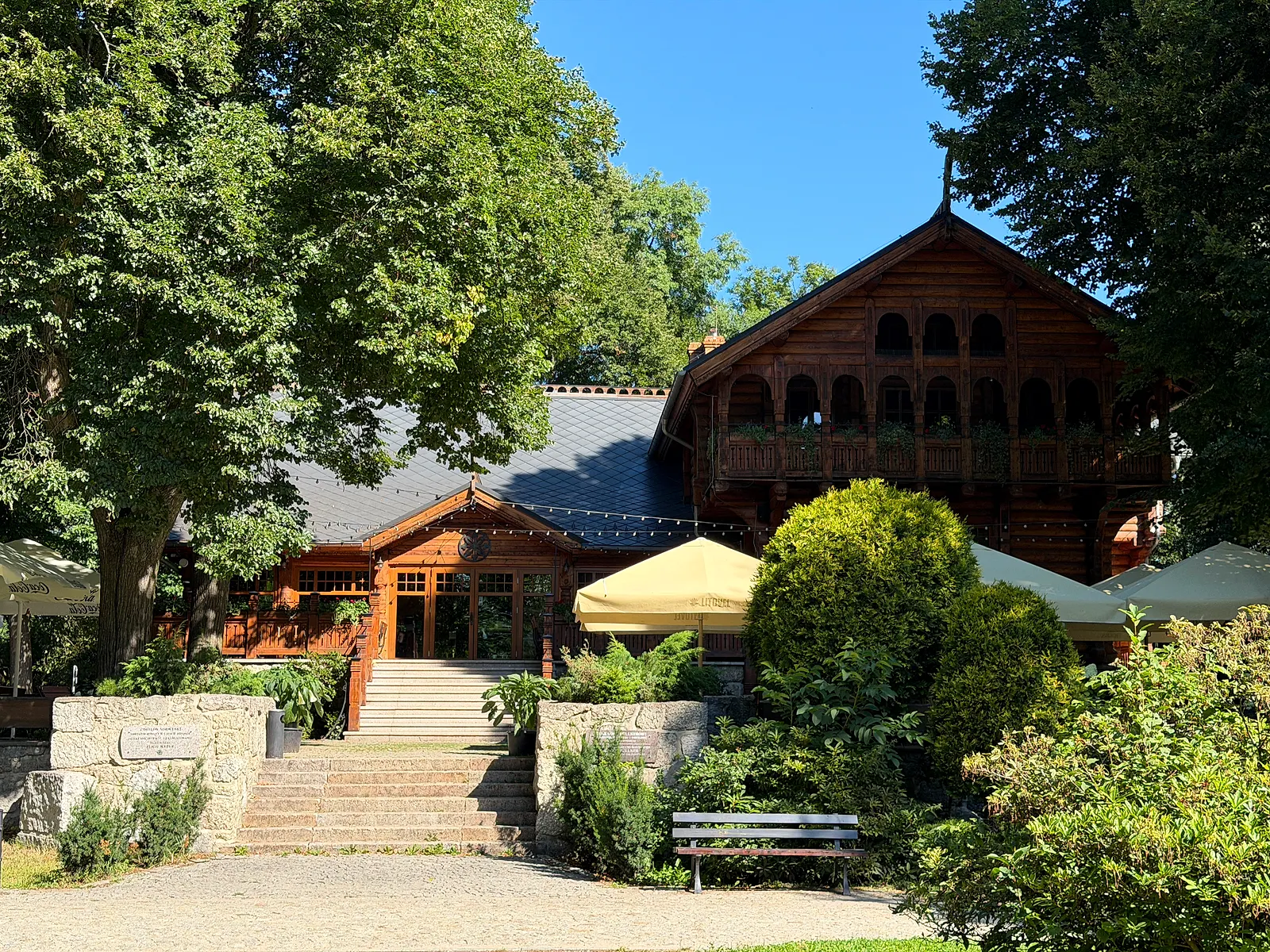
This building looks as though someone had carried it here from outside Oslo – and that is roughly what happened. It was built as a copy of the Frognerseteren restaurant above the Oslofjord, on the initiative of Eugen Füllner, owner of the Cieplice paper machine factory, who announced in 1906 that he would put it up for the silver wedding of the imperial couple. Emperor Wilhelm II loved Norway enough to travel there twenty-six times. Füllner knew the country for a quite different reason: he bought machines there.
An industrialist who built a housing estate, then a park
Before the pavilion came the park – and that is the more important part of this story.
Eugen Füllner owned a thriving paper machine factory in Cieplice. For the workers of his factory he built a housing estate, and from 1906 he began to surround it with an extensive park. To lay out the greenery he hired Fritz Hanisch, a garden and park designer from Wrocław.
This explains something that is not obvious about today's Norwegian Park: the park was not created for spa guests, as the Spa Park a few hundred metres away was, but for workers. Only with time did people start calling it Norwegian – after the building that stood in it.
Why Norway of all places
There are two reasons, and both are true.
The first is imperial. Wilhelm II adored Norway and organised twenty-six expeditions there. So when Füllner announced in 1906 that he would raise a building in the Norwegian style in his park to mark the silver wedding of the imperial couple, the gesture was perfectly legible to everyone.
The second is professional and less known. Füllner himself travelled to Norway, because at that time the Norwegians led the field in paper machine manufacturing. He went there on business and saw the architecture with his own eyes. The gift for the emperor was thus also a souvenir of a business trip.
A copy of a building above the Oslofjord
The design was made by Einar Smith, a pupil of Holm Hansen Munthe – the architect regarded as the creator of the Norwegian national style and author of the Frognerseteren restaurant, built in 1880 on the slopes above the Oslofjord. The Cieplice pavilion was built on the model of Frognerseteren.
The material matches the original: profiled spruce logs, set however on foundations of Karkonosze granite – a Norwegian shell on local stone.
Look up at the ridge of the roof. It is crowned with “dragon heads” recalling the prows of Viking ships – the most recognisable mark of this style, which is sometimes called the dragon style because of them. The other details are Scandinavian too: this is not a building “with motifs” but a consistent copy.
The interiors were finished by the School of Woodcarving in Cieplice – an institution that owed its foundation in large part to Füllner himself. The founder of the building was thus also the founder of the school that decorated it.
Construction was completed in 1909 (the board by the pavilion gives 1908).
Restaurant, museum, restaurant again
The building was raised as a restaurant and served as one for years.
After the war it changed function: from 1967 to 2013 it housed the Natural History Museum. This is where the natural history collections from the Long House ended up – birds, minerals, insects – and it was from them that the institution now based in the former Cistercian monastery began.
After the museum moved out, the building passed to a new owner and was renovated. Today a restaurant works here again – after more than a hundred years the building has returned to the function it was built for.
Two parks, two publics
Cieplice has two large parks, and it is worth knowing that they came about for entirely different reasons – one of the more interesting things this town lets you read from its greenery.
The Spa Park is older, going back to 1713, and grew beside the palace as a setting for the spa. Schaffgotsch divided it into two parts: a castle part, open only to the residents of the palace, and a spa part – for everyone else. The border ran between those who lived here and those who had come for treatment.
The Norwegian Park was created two hundred years later, with the opposite intention. It was laid out by a manufacturer around a housing estate built for his own workers, and the planting was handled by a professional designer from Wrocław. Nothing here was reserved for anyone.
Walking the trail, then, you pass in a quarter of an hour between two ideas about who a park is for: from a division into the better sort and the rest, to greenery planted beside workers' houses.
What is around
The pavilion stands in the Norwegian Park, right beside the Wrzosówka river. In front of the building there is a pond with a historic stone bridge and a floodlit fountain, and above the water a gazebo that photographs better than the pavilion itself. Nearby there are also a sports pitch, a playground and an outdoor gym – the park still does what it was founded for: it serves residents, not tourists.
The city states that the pavilion is among the oldest buildings of its kind in Europe. I have not found a comparison that confirms this, so I leave it as municipal information rather than a fact – although the style and the date make it plausible.
Frequently asked questions
Who built the Norwegian Pavilion?
Eugen Füllner, owner of the Cieplice paper machine factory, announced the building in 1906 to mark the twenty-fifth wedding anniversary of the imperial couple. The design was made by Einar Smith, a pupil of Holm Hansen Munthe.
Why does it look like a building from Norway?
Because it is a copy of the Frognerseteren restaurant near Oslo, built in 1880. Füllner knew Norway from business trips – the best paper machines were bought there at the time.
Where do the dragon heads on the roof come from?
They are the hallmark of the Norwegian national style, recalling the prows of Viking ships.
Can I go inside?
Yes – there is a restaurant in the building. Earlier, from 1967 to 2013, it housed the Natural History Museum.
Is the Norwegian Park Norwegian too?
The name came later. Füllner laid the park out from 1906 around a housing estate built for the workers of his factory, and it was designed by Fritz Hanisch from Wrocław. It began to be called Norwegian only because of the pavilion.
