 Szlak Jelonków
Chojnik Castle – ruins and panorama above Sobieszów
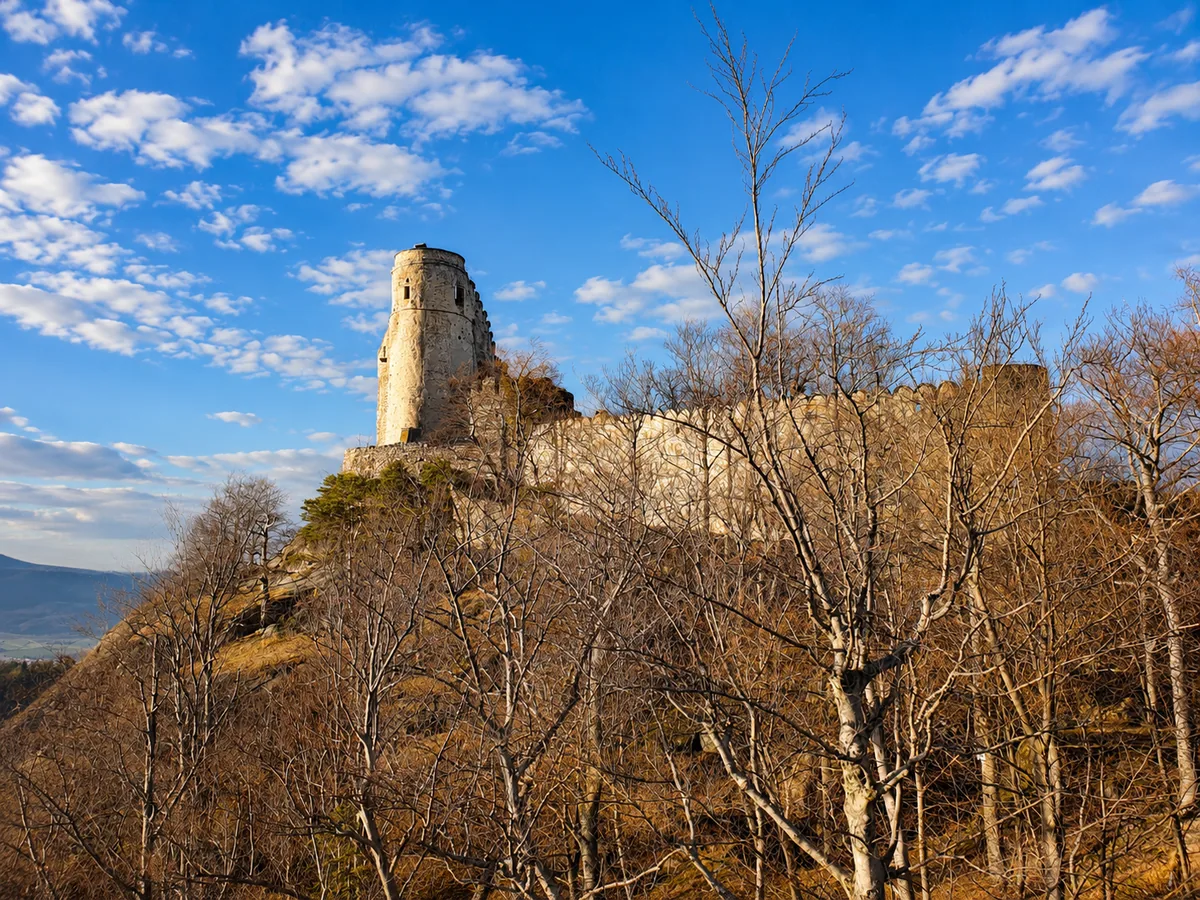
Chojnik Castle (German Kynast) is one of the finest ruins in Lower Silesia – a Gothic stronghold on the summit of a rocky mountain (627 m) above Sobieszów, a district of Jelenia Góra. A sweeping panorama of the Karkonosze opens from its tower, and the most famous mountain legend – of cruel Kunigunde – surrounds its walls.
The history of Chojnik Castle
The stone castle was built in the 1350s, with the first mention dating from 1364. From 1418–1419 Chojnik belonged to the powerful Schaffgotsch family, who extended it through the 15th and 16th centuries – in 1588–1589 the cylindrical keep was raised. The fortress was built directly on the granite rock, defended on the south-east by a 150-metre cliff above the Hell Valley. Its glory ended with a lightning fire on 31 August 1675 – Chojnik was never rebuilt.
As early as the 19th century the picturesque ruin became a destination for excursions; a mountain shelter has operated here since 1860, today run by the PTTK. Since 1991 the castle has hosted the “Golden Bolt of Chojnik Castle” crossbow tournaments. The mountain lies within the Karkonosze National Park.
The legend of Kunigunde
Chojnik is linked with the most famous legend of the Karkonosze – about the beautiful but cruel princess Kunigunde, who would marry only the man who, in full armour, could ride a horse around the narrow castle walls above the precipice. Read the full legend →
Visiting – how to get there, tickets, opening hours
The easiest start is from Sobieszów. The car park for National Park visitors is by the palace, entered from Krystaliczna Street, and you can also park free of charge on the streets of the district centre. A short way off, on Cieplicka Street by the bus loop below the palace, stands the Bolko III little deer of the Little Deer Trail. Two marked trails lead up: the red one – gentler and more comfortable, and the black one – shorter but steeper, passing the Zbójeckie Skały rocks on steps hewn into the stone. Either way the climb takes about an hour, children included.
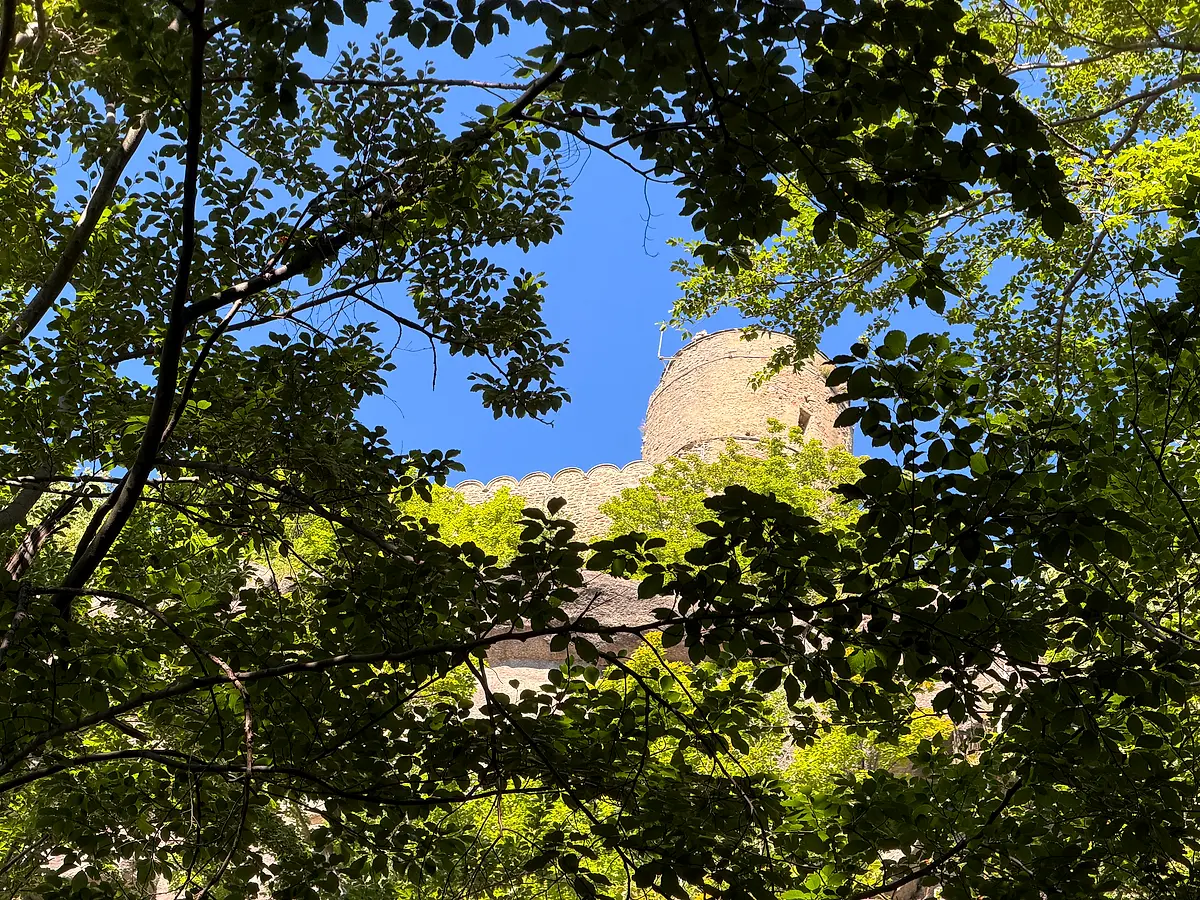
The mountain lies in an enclave of the Karkonosze National Park, so two separate tickets apply: park admission and castle admission. Prices and opening hours change with the season – check them before you set out. A PTTK mountain shelter with a snack bar operates in the courtyard, and the climb up the tower ends at the viewing platform with the panorama you can explore below.
360° panorama from the tower
 Loading panorama…
 Drag to look around; scroll to zoom. The visible peaks are labelled on the panorama.
Full list of visible features (text)
Mountain ranges
Karkonosze · Góry Izerskie · Rudawy Janowickie · Góry Kaczawskie
Peaks and rocks
- Komorzyca
- Grodziec
- Ostrzyca
- Stromiec
- Lastek
- Godzisz
- Leśniak
- Grapa
- Góra Szybowcowa
- Leśnica
- Łysa Góra
- Widok
- Źróbek
- Kobyła
- Ogier
- Okopowa
- Sołtysia
- Folwarczna
- Skopiec 724 m n.p.m.
- Baraniec
- Połom
- Dudziarz
- Przełęcz Radomierska
- Różanka
- Ołowiana
- Witosza
- Turzec
- Sokolik
- Poręba
- Krzyżna Góra
- Lwia Góra
- Grodna
- Wołek
- Mrowiec
- Dzicza Góra
- Bielec
- Wielka Kopa
- Skalnik 945 m n.p.m.
- Ostra Mała
- Bobrzak
- Rudnik
- Głaśnica
- Przełęcz Kowarska
- Grabowiec
- Kaplica św. Anny
- Wołowa Góra
- Czoło
- Kowarski Grzbiet
- Skalny Stół
- Czoło
- Sowia Przełęcz
- Czarna Kopa
- Czarny Grzbiet
- Kopa
- Śnieżka 1603 m n.p.m.
- Pielgrzymy
- Słonecznik
- Smogornia
- Kopa
- Tępy Szczyt
- Mały Szyszak
- Sucha Góra
- Przełęcz Karkonoska
- Ptasi Kamień
- Przełęcz Dołek
- Śląskie Kamienie
- Góra Żar
- Czeskie Kamienie
- Śmielec
- Wielki Szyszak
- Śnieżne Kotły
- Łabski Szczyt
- Mokra Przełęcz
- Szrenica
- Końskie Łby
- Sośnik
- Grzybowiec
- Trzmielak
- Kątnik
- Czerwone Skałki
- Młynik
- Wysoki Kamień 1058 m n.p.m.
- Czarna Góra
- Przednia Kopa
- Zakręt Śmierci
- Stóg Izerski
- Kamienica
- Jastrzębiec
- Kowalówka
- Kozia Szyja
- Tłoczyna
- Mały Ciemniak
- Ciemniak
- Borowe Skały
- Zaroślak
- Bukowa
- Ptak
- Kamionek
- Wilcza Góra
- Rozróg
- Sroczka
- Gniazdo
Towns and districts
- Sobieszów
- Goduszyn
- Cieplice Śląskie-Zdrój
- Jelenia Góra
- Marczyce
- Podgórzyn
- Mysłakowice
- Sosnówka
- Kowary
- Zachełmie
- Borowice
- Jagniątków
- Górzyniec
- Piechowice
- Pakoszów
- Wojcieszyce
What you can see from the Chojnik tower
From the platform atop the keep (the main, cylindrical tower) a sweeping panorama opens. To the south runs the main ridge of the Karkonosze – from Szrenica, through Łabski Szczyt, the Śnieżne Kotły cirques and Wielki Szyszak, to the highest peak, Mount Śnieżka (1603 m). To the east lie the Rudawy Janowickie with Skalnik, and at the foot of the hill the Jelenia Góra Valley with Sobieszów, Cieplice and Jelenia Góra.
Frequently asked questions
Where is Chojnik Castle?
On the summit of Chojnik mountain (627 m) above Sobieszów – a district of Jelenia Góra in the Karkonosze. On the south-east the mountain drops in a 150-metre cliff into the Hell Valley.
When was Chojnik Castle built?
The stone castle was built in the 1350s, with the first mention dating from 1364. From 1418–1419 it belonged to the Schaffgotsch family. On 31 August 1675 a lightning fire turned it into a ruin that was never rebuilt.
What can you see from the Chojnik tower?
A panorama of the main Karkonosze ridge from Szrenica to Mount Śnieżka (1603 m), the Rudawy Janowickie with Skalnik, and the Jelenia Góra Valley with Sobieszów, Cieplice and Jelenia Góra.
What legend is connected with Chojnik Castle?
The most famous legend of the Karkonosze – about the cruel princess Kunigunde, who would marry only the man who could ride in armour around the castle walls above the precipice.
How long does the climb to Chojnik Castle take?
About an hour from Sobieszów – via the red trail (gentler) or the black one (shorter and steeper, past the Zbójeckie Skały rocks). The climb is manageable with children too.
Is there an entrance fee to Chojnik Castle?
Yes – a castle ticket applies, plus a separate ticket to the Karkonosze National Park, in whose enclave the mountain lies. The castle is open all year round, off-season usually Tuesday to Sunday.
