 Szlak Jelonków
Jelenia Góra Town Trail · the long route · Cieplice
Drinking fountain
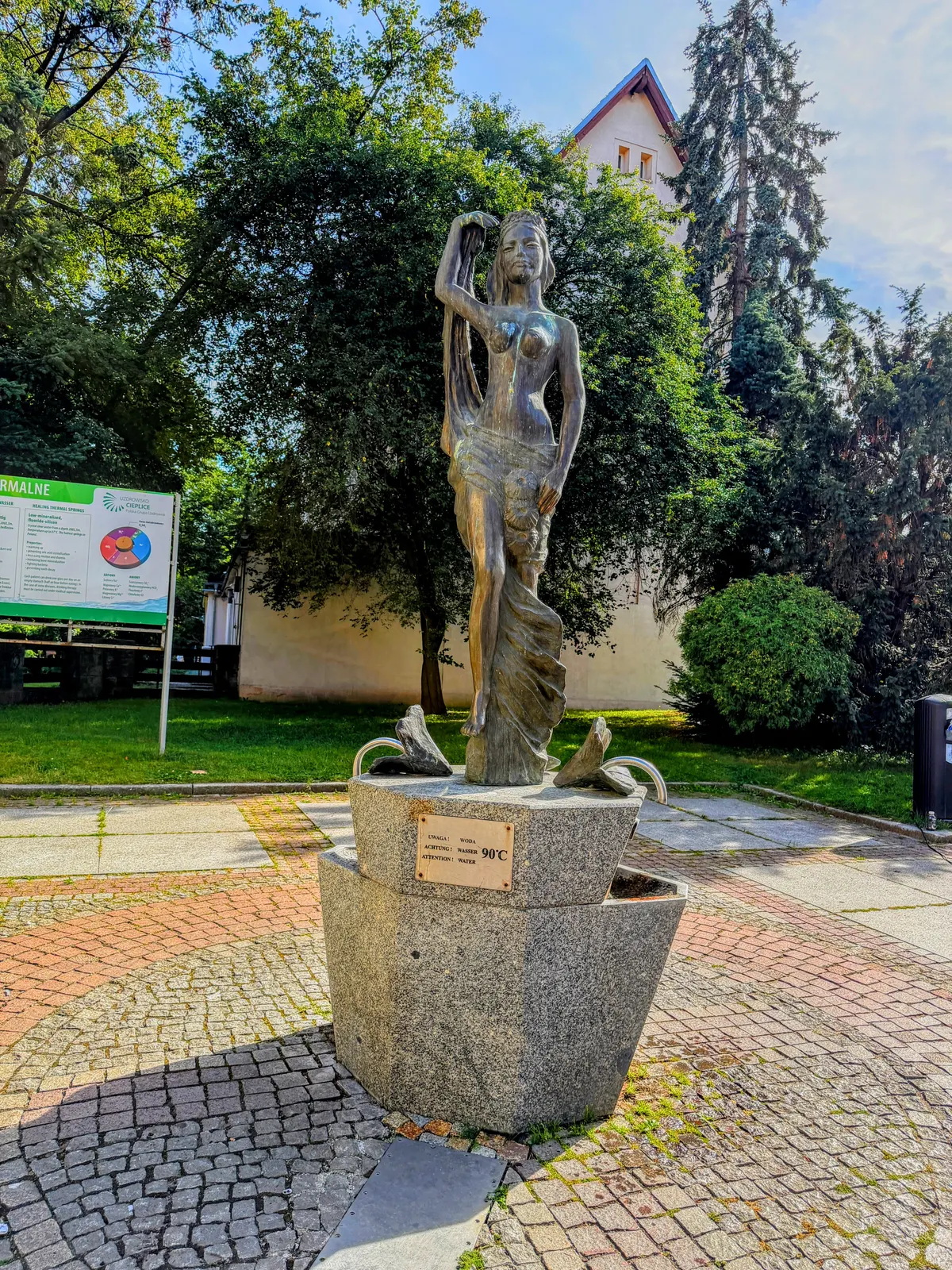
This whole trail is a story about water – and this is the one place where you can taste it. At the feet of a sculpted nymph, from three stone flowers, flows water drawn from a depth of 2,002.5 metres, at a temperature of 87 degrees. On the plinth hangs a plate that does not mince words: CAREFUL! WATER 90°C.
Water reached two kilometres down
The board of the Cieplice spa company, a few steps from the sculpture, gives figures worth pausing over. Crystal-clear water at 87 °C, drawn from a depth of 2,002.5 metres. The English version adds it plainly: the hottest springs in Poland.
Set beside the Marysieńka spring, it shows the scale of progress. In 1853 they drilled here to 167 metres, and that was a breakthrough investment. Today the intake reaches more than twelve times deeper.
The water is fluoride-silica and weakly mineralised – meaning it does not taste like brine, though it carries sodium, calcium, potassium, magnesium and lithium, sulphates, bicarbonates, fluorides and chlorides, and metasilicic acid as well. It was fluorine and silica, not the temperature alone, that built the reputation of Cieplice.
A nymph that replaced birds
The sculpture is called “Water Nymph 'Zdrój'” and was placed here in June 2009. It was made by Maria Bor – in full Maria Bor-Myśliborska, born in 1932 in Warsaw, a graduate of the Sopot academy, who died in 2020. The Cieplice nymph is thus one of her late works.
It shows a half-naked woman with loose hair and a wreath of flowers; in a raised hand she holds a cloth that falls around her hips. The important part, however, happens at her feet: three open flowers with warm water flowing from them. The sculpture does not stand beside the intake – it is the intake.
A detail that says something about this place: the nymph replaced an earlier ornament of the same intake, also by Maria Bor, titled “Birds”. The same sculptor dressed the same stream of water twice.
The initiative came from the management of the Cieplice spa company, but the work was carried out and mostly paid for by the city of Jelenia Góra.
Before you drink
The water is hot – the plate on the plinth warns of ninety degrees, while the documentation of the intake says eighty-seven. The difference does not matter in practice: at such a temperature, rounding up is sensible.
The spa company also gives a rule worth taking seriously, because this is not table water: one glass a day, on an empty stomach, half an hour before a meal. And a sentence not to be skipped: for some conditions a drinking cure must be supervised by a doctor.
The board lists the effects: it warms strongly, prevents the crystallisation of uric acid and the formation of kidney stones, acts as a diuretic, increases bone mineralisation, acts against bacteria and prevents tooth decay. That is information from the operator of the intake, not my advice – and with water of this composition it is worth remembering.
Three different waters on one trail
On this route it is easy to confuse three quite different things, because all of them are wet and all are meant to heal.
Thermal water for drinking – the one from this fountain. Drawn from over two kilometres down, hot, weakly mineralised, fluoride-silica. You drink one glass of it.
Thermal water for bathing – the same family of waters used by the thermal baths and treatment facilities of the spa, and the point of eight hundred years of this place's history: to immerse yourself in it.
Brine in the graduation tower on the Kamienna – and that is another story altogether. A graduation tower needs heavily salted water, and the Cieplice water is exceptionally poor in salts. The aerosol you breathe there has nothing to do with the water from this fountain.
So if somebody in Cieplice says “our water”, it is worth asking which one.
What "fluoride-silica" means
The name on the board sounds like a manual, but it says something simple: there is little salt in this water and a good deal of fluorine and silica.
It is a rare combination, and it was this, not the temperature alone, that built the spa's reputation. The board also lists lithium in the composition – an element not often found in mineral waters – and metasilicic acid, the form in which silica occurs in water.
The spa company links this composition with specific effects: from an influence on bones and the prevention of kidney stones to protection against tooth decay. That is information from the operator of the intake, not advice – and with water of this composition it matters who may drink it and how much.
Where it is
The fountain stands at the western entrance to Plac Piastowski from ul. Cieplicka, so walking the trail you pass it between the Norwegian Pavilion and the former monastery complex – on the way, without a detour.
Frequently asked questions
Can I drink from this fountain?
Yes, it is an intake of medicinal water. The spa recommends one glass a day, on an empty stomach, half an hour before a meal. For some conditions a drinking cure should be supervised by a doctor.
How hot is the water?
The spa board gives 87 °C and the plate on the plinth warns of 90 °C. Either way – it is boiling hot.
Where does the water come from?
From a borehole 2,002.5 metres deep. These are the hottest thermal waters in Poland.
Who sculpted the nymph?
Maria Bor (Maria Bor-Myśliborska), in June 2009. The sculpture replaced her earlier work “Birds”, which decorated the same intake.
Is this water salty?
No. It is weakly mineralised, fluoride-silica – quite different from the brine used in the graduation tower on the Kamienna.
