 Szlak Jelonków
The Grave of the Unknown Priest
On the forest edge between Cieplice and Staniszów, at 416 m above sea level, lies a grave with no name on it. All that is known is that a clergyman rests there and that he died towards the end of the war. Everything else – even his denomination and nationality – is guesswork. And yet a candle burns there almost always.
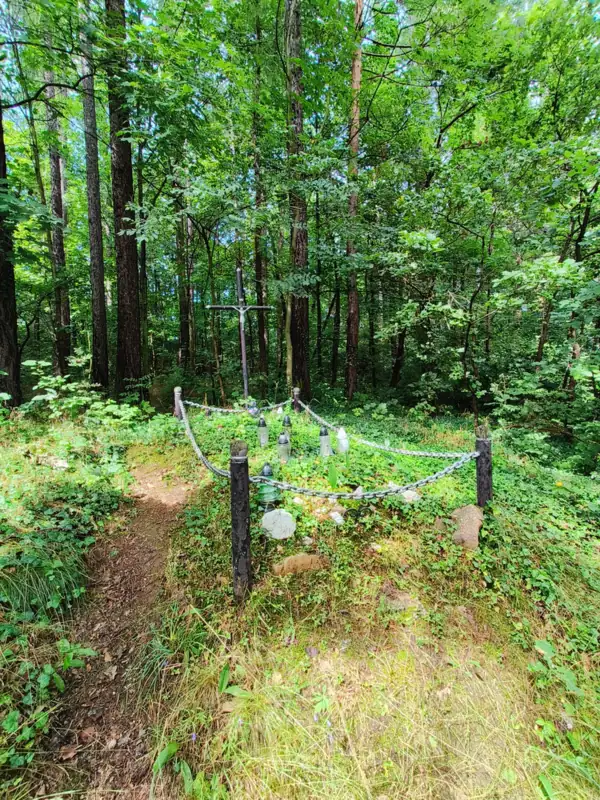
What is actually known
The list of facts is short, and that is the heart of this story. We do not know his name. It is not known whether he was a Catholic priest or a Protestant pastor, nor whether he was Polish or German. The date of burial – around 1944 – comes from what the people of Staniszów remembered, not from any register.
The search went further than stories. Monsignor Józef Stec, for many years the parish priest in Cieplice, wrote about the matter to the archive in Berlin. Not a single document was found – neither about the burial nor about a clergyman dying in this area.
Four versions of one death
Older residents of Staniszów remembered four accounts that are hard to reconcile:
- Hanged by the SS – for ministering to prisoners of the camp in Cieplice.
- Torn apart by horses – the most drastic version and the least likely, yet still repeated.
- Suicide – in this version, a grave outside the cemetery is explained by church custom.
- A robbery – an accidental death, with nothing to do with the war or politics.
Asked about the place, Father Stec said that “a member of the clergy is certainly buried here” and that this was a man “who stood up for those who thought differently”. He also stressed that the memory of this grave teaches something – and that sentence explains more than any of the four versions.
Context that must not be mistaken for an explanation
In 1944 Cieplice – then Bad Warmbrunn – had a subcamp of the Gross-Rosen concentration camp, the Arbeitslager Bad Warmbrunn. It held between 600 and 800 Jewish men, mostly from Poland and Hungary, but also from Belgium, the Netherlands, Greece and Czechoslovakia. They worked in the Dörries-Füllner paper machinery works, converted to arms production. In the winter of 1944/1945 a typhus epidemic swept the camp; some 400 prisoners died.
This is the background of the time and the place – it is not an explanation of the grave. No known document links that camp with the burial on the forest edge, and the account of a priest ministering to the prisoners sits awkwardly with the fact that the Cieplice camp held Jewish prisoners. Forced labourers from other countries worked in the area too, and there were other places of confinement. Anyone telling this story honestly has to leave the question open.
How to get there
The grave lies at the end of a green walking trail that starts in Cieplice on Poprzeczna street, at the corner of Ceglana. The trail is 2.1 km long and ends exactly here – it leads nowhere further. It climbs all the way, but gently: from 337 to 417 m above sea level, eighty metres spread over two kilometres, and not a single metre of descent. The first 400 metres are streets (Poprzeczna, Michejdy), then forest roads, and the last 400 metres are bare ground that softens after rain. At an easy pace – about 35 minutes.
Roughly halfway, at kilometre 1.2, a spring sits right beside the path – five metres off it.
At kilometre 1.64 the trail merges with the red loop of the Main Cieplice Walking Trail and for 111 metres the two run together on one track. Then the waymarks part: the red one branches off, the green one keeps climbing and ends at the grave 330 metres later.
Watch the waymarks: Cieplice has two walking trails marked with the same white-and-green square. The other one is a loop around the spa quarter, several kilometres from here, and has nothing to do with the grave.
The Szlak Jelonków app guides the same route – with GPS, voice hints and a map that works without a signal. Two things to keep in mind on the way. This is still a grave – silence and nothing more. And this is a forest: better not to leave an open flame here. If you want to leave a light, a battery-powered one is the safe choice.
