 Szlak Jelonków
The coat of arms of Jelenia Góra – a red deer on three hills
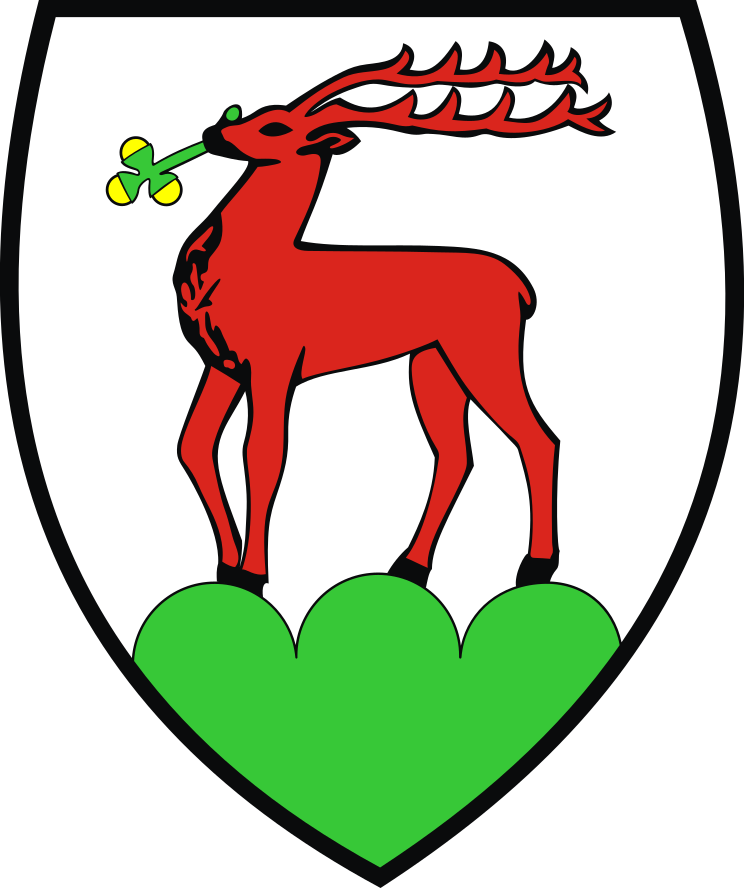
The arms of Jelenia Góra are classic canting arms – their content repeats the name of the town. A red deer stands on three green hills, holding three golden acorns in its mouth. That same deer returns to the city today in an entirely new form: as 30 little-deer sculptures scattered through the streets.
What the coat of arms looks like
On a silver shield a red deer, turned to the right, standing on three green hills. In its mouth the deer holds three golden acorns joined by a single green stem.
“To the right” means the heraldic right – that is, to the viewer's left. It is a standard convention of heraldry, and a common source of confusion. The three green hills are called a trimount in heraldry (German Dreiberg).
What the elements mean
The deer is a canting device: the German name of the town, Hirschberg, means literally “deer mountain”. The oldest legend links the town's beginnings to a ducal hunt – by tradition that of Bolesław the Wrymouth – who chased a deer and founded a stronghold on the hill. The trimount answers the second half of the name: the mountain.
The greatest confusion concerns what the deer holds in its mouth. The Polish description speaks of three golden acorns on one green stem – but from a distance they form the shape of a three-leaf clover, and that is exactly how German heraldry describes them (“a stylised three-leaved clover”). It is the same charge, named differently on each side of the border.
The history – a forged diploma and a return to the original
The deer has accompanied the town since the Middle Ages, but the arms themselves had a turbulent history. During the Thirty Years' War the merchants of Jelenia Góra raised the standing of the municipal emblem on their own authority – the change was probably made before 1629. To justify it, a forged armorial diploma was produced: the documents were backdated to 1599 and attributed to a supposed grant by Emperor Rudolf II, and their discovery was announced only during the war. The new appearance was finally sanctioned by Emperor Ferdinand II on 30 September 1630.
The deer was moved onto a two-coloured, two-field shield, and elements typical of noble arms were added: a helm, crest and mantling. In that form the arms survived for over three centuries – until 1937, when the original appearance was restored.
Today the pattern is governed by the City Statute – resolution no. 61.VII.2019 of the Jelenia Góra City Council of 27 March 2019.
The pre-1945 version – the one you still find online
An older variant of the arms, used until 1945, still circulates online: a shield divided diagonally into a silver and a blue field, with the deer shown running and carrying a clover leaf in its mouth. The image is striking and easily mistaken for the current arms – but it is the historical version. Today's arms have a plain silver shield, a standing deer and a trimount.
The arms and the Little Deer Trail
The little-deer sculptures that have been appearing in Jelenia Góra since 2020 are a modern echo of the heraldic deer – the same one that has stood in the arms since the Middle Ages and that gave the town its name. Each of the 30 little deer has its own character and story; you will find them all on the trail map.
