 Szlak Jelonków
Jelenia Góra Town Trail · the long route · extra point · Jagniątków
The Oak of Peace
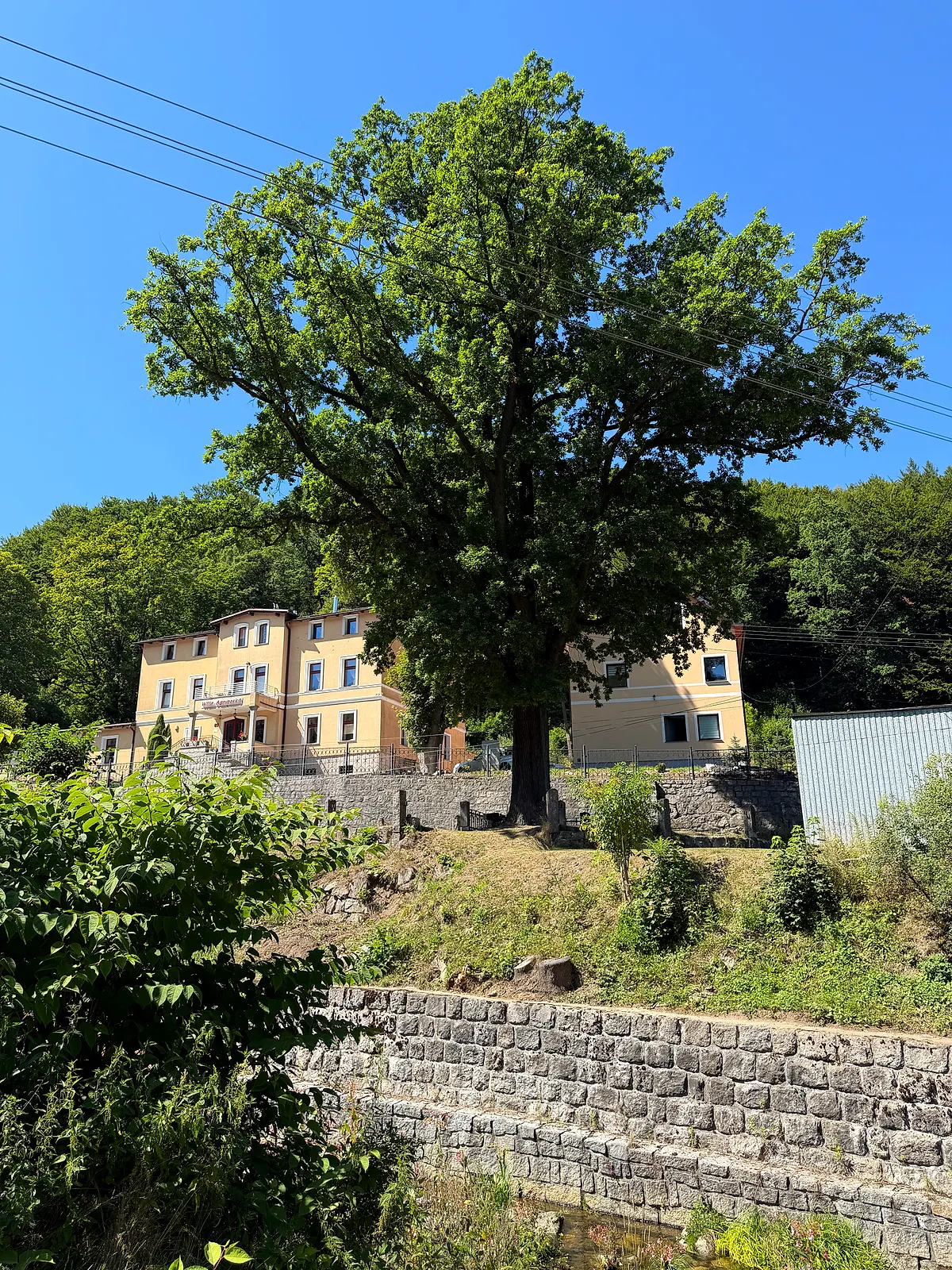
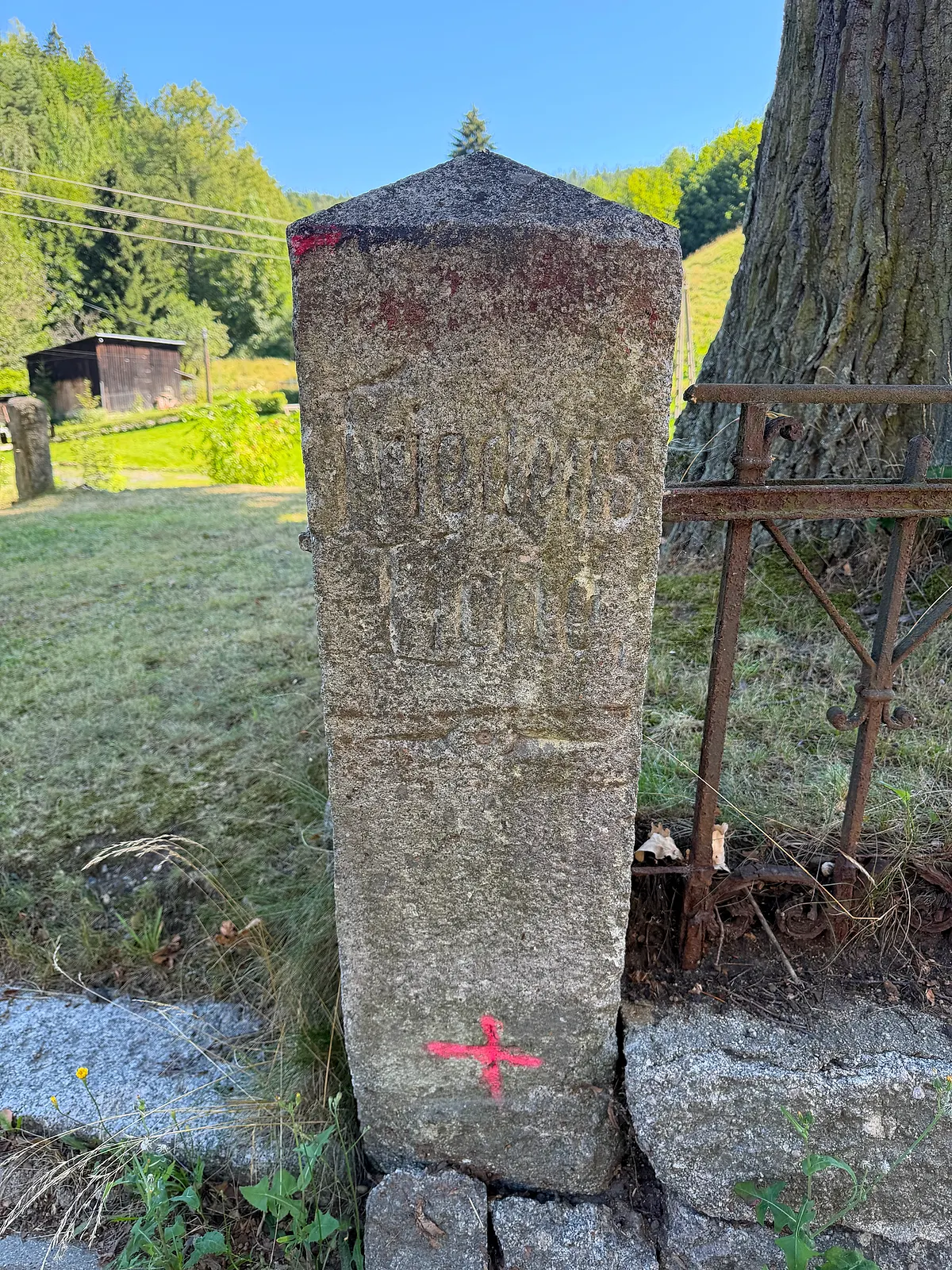
By the road in Jagniątków grows an oak that people pass without stopping – a pity, because it is a tree with a date. It was planted to mark the end of the Franco-Prussian war in 1871, and on the posts of the fence around it you can still read “Friedens Eiche” and that very date. The fence is a ruin now. The inscription has stayed.
What an "oak of peace" means
After the victory over France and the unification of Germany in 1871, Friedenseichen – oaks of peace – were planted across the Reich. They were usually accompanied by a commemorative stone or a fence with the date carved into it, exactly as here.
The choice of tree was not accidental: in this symbolism the oak served as the national tree. Nor was the sense of the word “peace” accidental. It meant less the end of the fighting with France than a lasting peace among the German states, which had just joined into one empire.
The Jagniątków oak is therefore not a local curiosity but a local specimen of a custom that covered hundreds of places. All the more interesting because in many of them nothing is left of the oaks of peace – neither tree nor inscription.
A monument that is no longer there
Behind the tree, seen from the street, there once stood a memorial to the fallen of the First World War. It took the form of a stone wall with three plaques set between pillars, and on top a block with a carved sword and the dates: 1914 on the left, 1918 on the right.
The monument did not survive. What remains is the tree, the remnants of the fence and the inscription of 1871 – a memento of an earlier war, a generation older than the one the monument commemorated.
It is a pattern that repeats on this trail. In Cieplice, on ul. Cervi, a memorial to the fallen of the First World War also stood – and was also removed. With this difference: there the plinth survived and received a new monument, while here only the tree is left.
Two monuments that are gone, on one trail
This place is no exception. The trail today passes two sites of memorials to the fallen of the First World War – and they look entirely different.
In Cieplice, on ul. Cervi, a monument with a sculpture of a weeping woman and plaques with names was removed right after the Second World War. But the plinth survived, and in 1967 the Grunwald Swords were raised on it. The place changed its meaning without ceasing to be a place of memory.
In Jagniątków nothing is left but the tree. The stone wall with three plaques vanished, and what has survived commemorates a different war – that of 1871.
The removal of German war memorials from the lands taken over by Poland was a mass phenomenon and has its own scholarly literature. What is interesting is rather what was left behind: in one case a foundation for a new monument, in the other a tree nobody touched, because a tree does not look like a monument.
What "natural monument" means
The status of a natural monument is not an honorary title but legal protection. It covers individual works of nature of particular value – most often old, imposing trees, but also erratic boulders or rock formations. In practice it means that such a tree may not be felled or damaged, and that works in its surroundings require permission.
In the case of this oak, protection of nature meets commemoration: the tree is protected as a natural object, and the inscription beside it says why it was planted. It is not often that the two have to be read together.
What you will see on the spot
Above all the fence posts on the road side – it is on them that the words “Friedens Eiche” and the date 1871 are carved. The fence itself is in ruins today, so it is easy to take it for ordinary remains of stones; it is worth stepping up and looking for the letters.
The tree is a natural monument. If it was indeed planted in 1871, it is today about a hundred and fifty-five years old – which for an oak means a mature tree, but still not an old one.
Where it is on the trail
This place has a practical function on the trail: here the forest part of the route ends. The green trail coming down from Chojnik leads out just here, into the buildings of Jagniątków. From here the trail goes on along the blue trail, almost to the door of Gerhart Hauptmann's house – the last point of the route.
A good place for a break: you are already down, but not yet at the goal.
Photographs
Frequently asked questions
What is the Oak of Peace in Jagniątków?
A commemorative tree planted to mark the end of the Franco-Prussian war in 1871. Today it is a natural monument.
How do we know it is an oak from 1871?
From the inscription on the fence posts: “Friedens Eiche” and the date 1871. The inscription is still legible, even though the fence itself is in ruins.
What were oaks of peace?
Trees planted across Germany after 1871 to mark the victory over France and the unification of the German states. The oak was regarded as the national tree.
Did a monument stand here?
Yes, behind the tree: a memorial to the fallen of the First World War – a stone wall with three plaques and a block with a carved sword and the dates 1914 and 1918. It did not survive.
How do I get to Hauptmann's house?
From the Oak of Peace the blue trail leads almost to the museum building itself.
