 Szlak Jelonków
Jelenia Góra Town Trail · the long route · Jagniątków
Gerhart Hauptmann's House
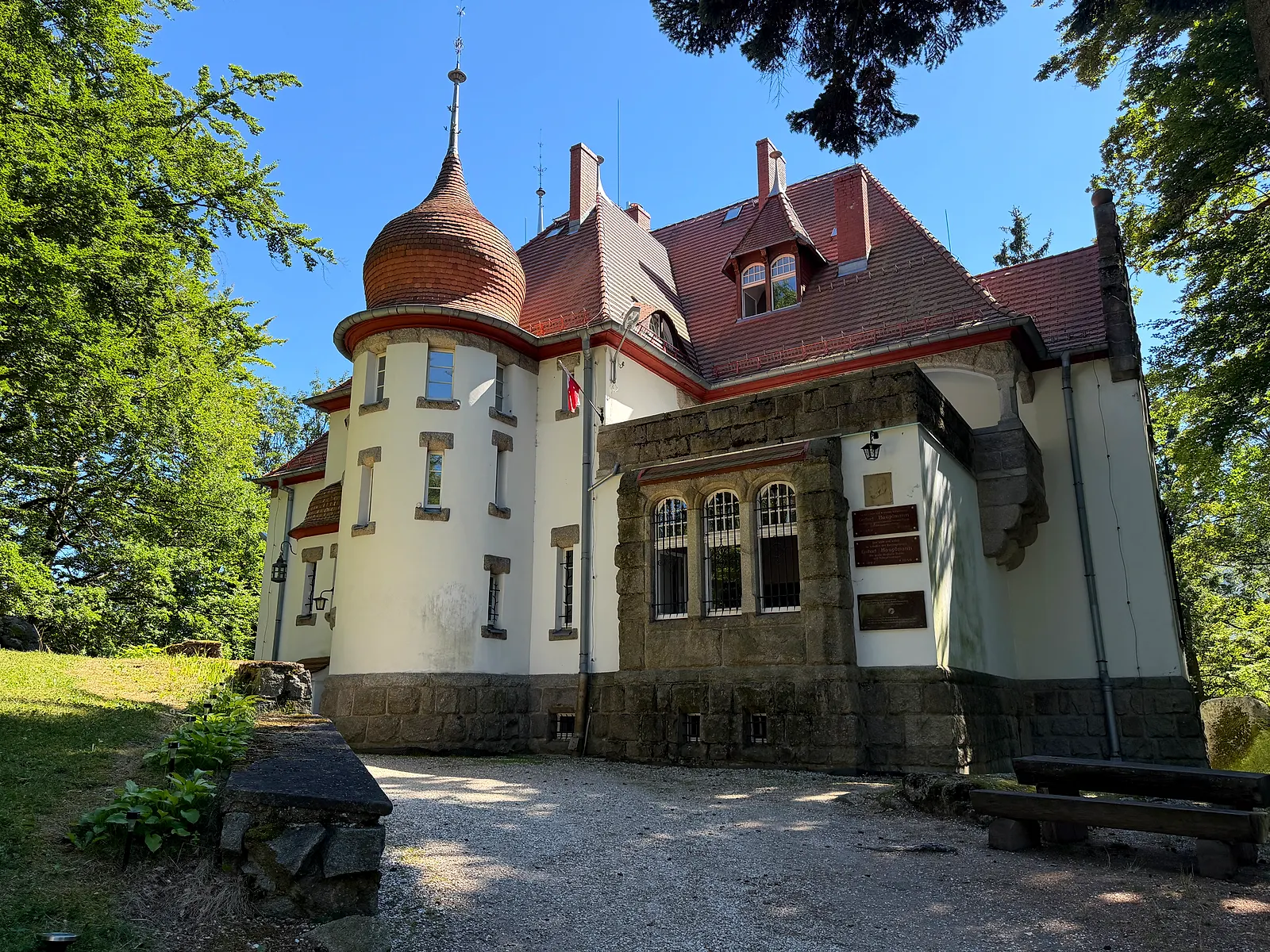
Gerhart Hauptmann received the Nobel Prize in Literature in 1912 and lived for almost half a century in Jagniątków – then Agnetendorf, today a district of Jelenia Góra. He called his house a “castle of defiance and defence”, because he fled here from the social whirl of Berlin. The Wiesenstein villa, the Meadow Stone, stands on a granite rock and ends the Grand Jelenia Góra Town Trail.
A house bought together with a view
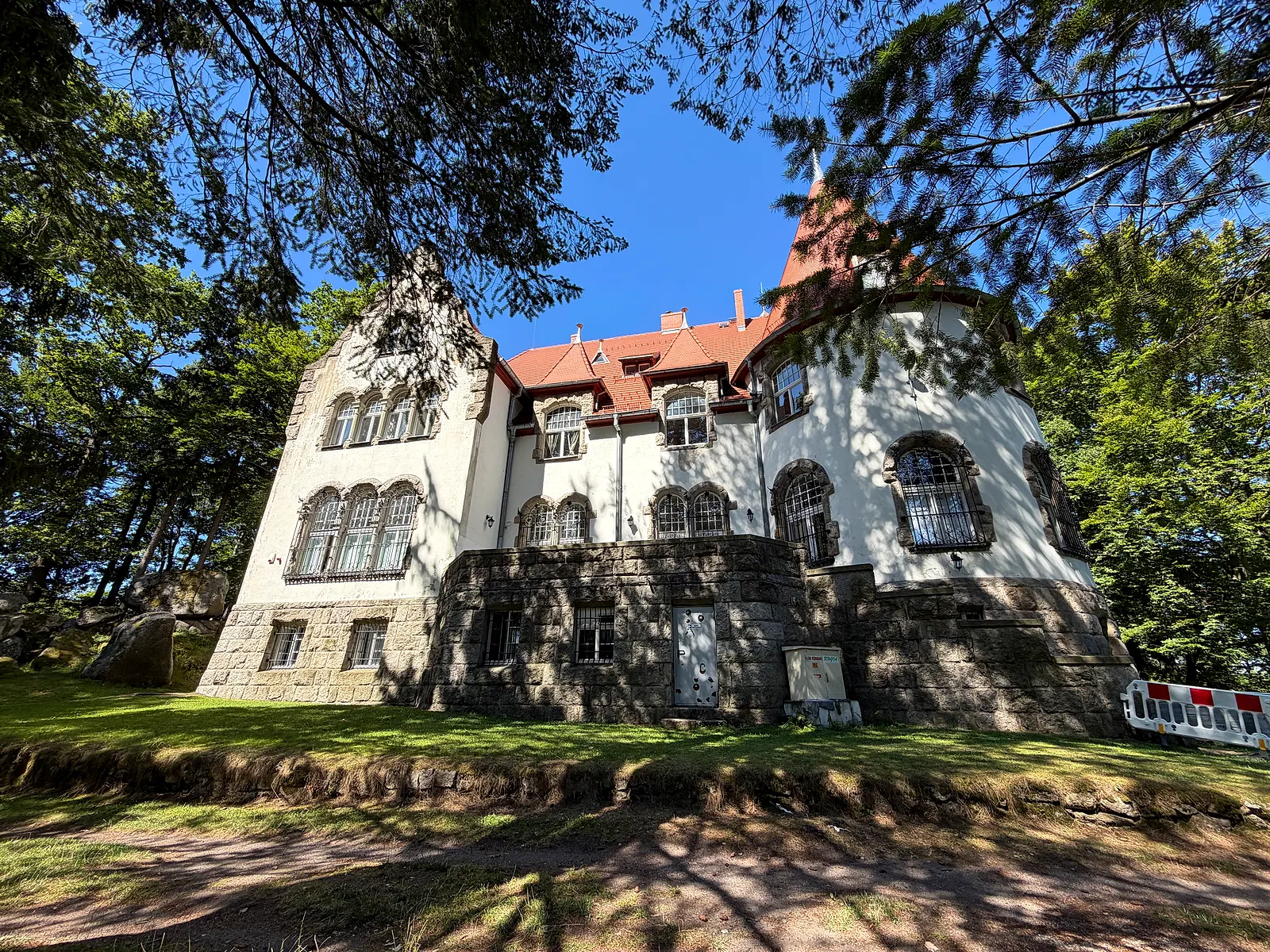
Hauptmann bought the plot on 30 October 1899, and the villa was built in 1900–1901 to a design by the Berlin architect Hans Grisebach. The building is massive and does indeed resemble a castle – architecturally a mixture of Historicism and neo-Renaissance, with two towers that sit well in a mountain landscape.
The siting, however, is the key: the house stands on a granite rock, in a park of about 1.6 hectares, and was from the start conceived as a villa with a view. From its windows and terraces a panorama of the Karkonosze opens out. It was not a house put up anywhere and admired afterwards – the view was in the design from day one.
"A castle of defiance and defence"
Hauptmann used words about this house that say more about him than about the architecture. He called it a “castle of defiance and defence” and “the rebuilding of my soul”, and told those who entered that whoever reaches this “temple of the soul” is granted an insight into his creative personality.
Behind those words lies a concrete need. The villa was a refuge between longer stays on the island of Hiddensee and in Italy, and above all an escape from the social whirl of Berlin and the public interest that followed the writer after the Nobel. The paradox is that this house of escape was for almost half a century at the same time a centre of the cultural and social life of artists, writers and intellectuals from the Karkonosze and Berlin circles – and was famous for its valuable art collections.
The Paradise Hall, or eight months of one painter
The most extraordinary interior of the villa was not created with it. The staircase received its present appearance only in 1922, for the owner's sixtieth birthday. It was covered with paintings by Johannes Maximilian Avenarius, a friend and artistic collaborator of Hauptmann's, and the work took him eight months.
What came of it was named the Paradise Hall – Paradieshalle. The paintings cover the walls and the ceiling, and their subjects mix orders: biblical and plant motifs, figures from mythology, characters from Hauptmann's own dramas, and among them portraits of the family – his wife Margarethe Marschalk and his son Benvenuto. A house told on its own walls.
The interior keeps that theatrical tone in the details too: massive carved wooden stairs lead up to a gallery, the floor is laid with terracotta in browns and blues in a geometric mosaic, a fireplace stands under the gallery, and the light comes through stained glass.
The work was probably financed by Max Pinkus, a Jewish industrialist from Prudnik and a devoted friend of the writer. That sentence is worth remembering, because ten years after this act of patronage the situation of such friendships in Germany would change beyond recognition.
Hauptmann Street, today Kochanowski Street
The regard the writer enjoyed was visible not only in Jagniątków. Until 1945 there was a Hauptmannstraße in Hirschberg – the Nobel laureate had a street named after him in the town during his lifetime, which is rare and says a good deal about his standing at the time.
Today it is Jan Kochanowski Street. The result is a symmetry nobody planned: a street named after a German Nobel laureate in literature was renamed after the war in honour of a Polish Renaissance poet. And in front of the Stefan Żeromski secondary school standing on it sits today the little deer Stefanek with an open book in his hooves – a third writer on the same street, this time in bronze.
The old names of Jelenia Góra's districts and the surrounding places are gathered separately on the page of German names of Jelenia Góra, and Stefanek can be found in the list of the deer.
A rock whose name was changed three times
A trace of Hauptmann remained in the Karkonosze as well, twenty-odd kilometres from here. The rock group Słonecznik on the slope of Smogornia bore the German name Mittagstein, the noon stone – it came from the fact that for the inhabitants of Podgórzyn, Przesieka and Borowice the sun standing above this rock meant midday. The name was therefore a clock.
In 1942, for the writer's eightieth birthday, the Riesengebirgsverein renamed Słonecznik the Gerhart Hauptmann Rock. It is the same association that sixty years earlier had begun gathering the exhibits from which the Karkonosze Museum grew. The new name was carved into the stone.
After the war the rock briefly bore the name Tetmajer Rock – after the Polish writer – until it returned to Słonecznik, that is, to the oldest and most practical meaning. The carved inscription was chiselled away, but a trace of it remains, and whoever knows what to look for will find it.
That is the second such story in this text. Hauptmann Street became Kochanowski Street, and his rock first Tetmajer's, then plain Słonecznik again. In these lands proper names tend to be the shortest-lived layer of the landscape.
Children's holidays in a Nobel laureate's villa
Hauptmann lived here until his death in 1946. Many ideas for the building followed, and the most prosaic won: the “Warszawianka” Children's Holiday Centre was set up, and until 1997 it took in children and young people for school holidays and field trips.
It would be hard to find a better image of the post-war change. For half a century children on school trips ran about beneath walls painted by Avenarius, and the Nobel laureate's house served a purpose its creator would never have imagined. That continuity of use had a side effect, though: the building survived because somebody needed it all along.
A museum that began with a declaration by two politicians
Just after the turning point of 1989, in line with a joint statement by the German Chancellor Helmut Kohl and the Polish Prime Minister Tadeusz Mazowiecki, it was decided to create a museum of the Nobel laureate in the villa. After municipalisation the building underwent a thorough renovation and restoration, supported by the Federal Government of Germany and the Foundation for German-Polish Cooperation.
On 1 September 2001 the Gerhart Hauptmann House was officially opened as a cultural institution of the City of Jelenia Góra, at a ceremony attended by the prime ministers of Poland and Saxony. Full museum status came only four years later – from 1 May 2005 the institution has worked as the Gerhart Hauptmann House Municipal Museum.
It is worth noting that this is one of the few places in the region where the Polish-German past is not a subject of dispute but the basis of a joint undertaking – from financing the renovation to the academic programme.
What is inside
The display covers editions of the books, photographs, the writer's personal belongings and works of art, and the interiors are arranged to convey the atmosphere of the age. The museum carries out research into the literature and history of Silesia, and organises temporary exhibitions, workshops, lectures and international conferences.
The greatest attraction, however, remains the Paradise Hall itself – one of the most beautiful interiors in Jelenia Góra, which cannot be seen anywhere else or even sensibly photographed whole.
Do not confuse it with the house in Szklarska Poręba
In Szklarska Poręba there is the Carl and Gerhart Hauptmann House – a branch of the Karkonosze Museum and an entirely different building, connected above all with the Nobel laureate's elder brother Carl. The Wiesenstein in Jagniątków is an independent municipal museum. The two are often confused, including in tourist materials.
What to see nearby
The museum ends the trail that begins in Cieplice. In Jagniątków itself stands the little deer Kubuś by the church of Divine Mercy, and the district reaches all the way to the main ridge of the Karkonosze, so this is where you set off into the mountains. Lower down lies Sobieszów with the ruins of Chojnik Castle, the fourteenth point of the same trail.
Photographs
Frequently asked questions
Who was Gerhart Hauptmann?
A German writer and dramatist, winner of the Nobel Prize in Literature in 1912. From 1901 until his death in 1946 he lived in Jagniątków, then called Agnetendorf.
What does the name Wiesenstein mean?
Meadow Stone. The villa stands on a granite rock, in a park of about 1.6 hectares.
What is the Paradise Hall?
The hall with the staircase, covered with paintings made in 1922 by Johannes Maximilian Avenarius for the writer's sixtieth birthday. The work took eight months, and among the paintings are portraits of Hauptmann's wife and son.
What was in the villa after the war?
The “Warszawianka” Children's Holiday Centre, which until 1997 took in children for school holidays and field trips.
Since when has the museum worked?
The house opened as a cultural institution on 1 September 2001, and has held the status of a municipal museum since 1 May 2005.
Is anything in the Karkonosze named after Hauptmann?
There was. In 1942, for the writer's eightieth birthday, the Riesengebirgsverein renamed the Słonecznik rock the Gerhart Hauptmann Rock and carved that name into the stone. After the war the rock briefly bore Tetmajer's name, and today it is Słonecznik again.
Is it the same house as the one in Szklarska Poręba?
No. In Szklarska Poręba there is the Carl and Gerhart Hauptmann House, a branch of the Karkonosze Museum. In Jagniątków there is the Wiesenstein villa – an independent municipal museum.
