 Szlak Jelonków
Jelenia Góra Town Trail · the short route
Orthodox church of St. Peter and Paul
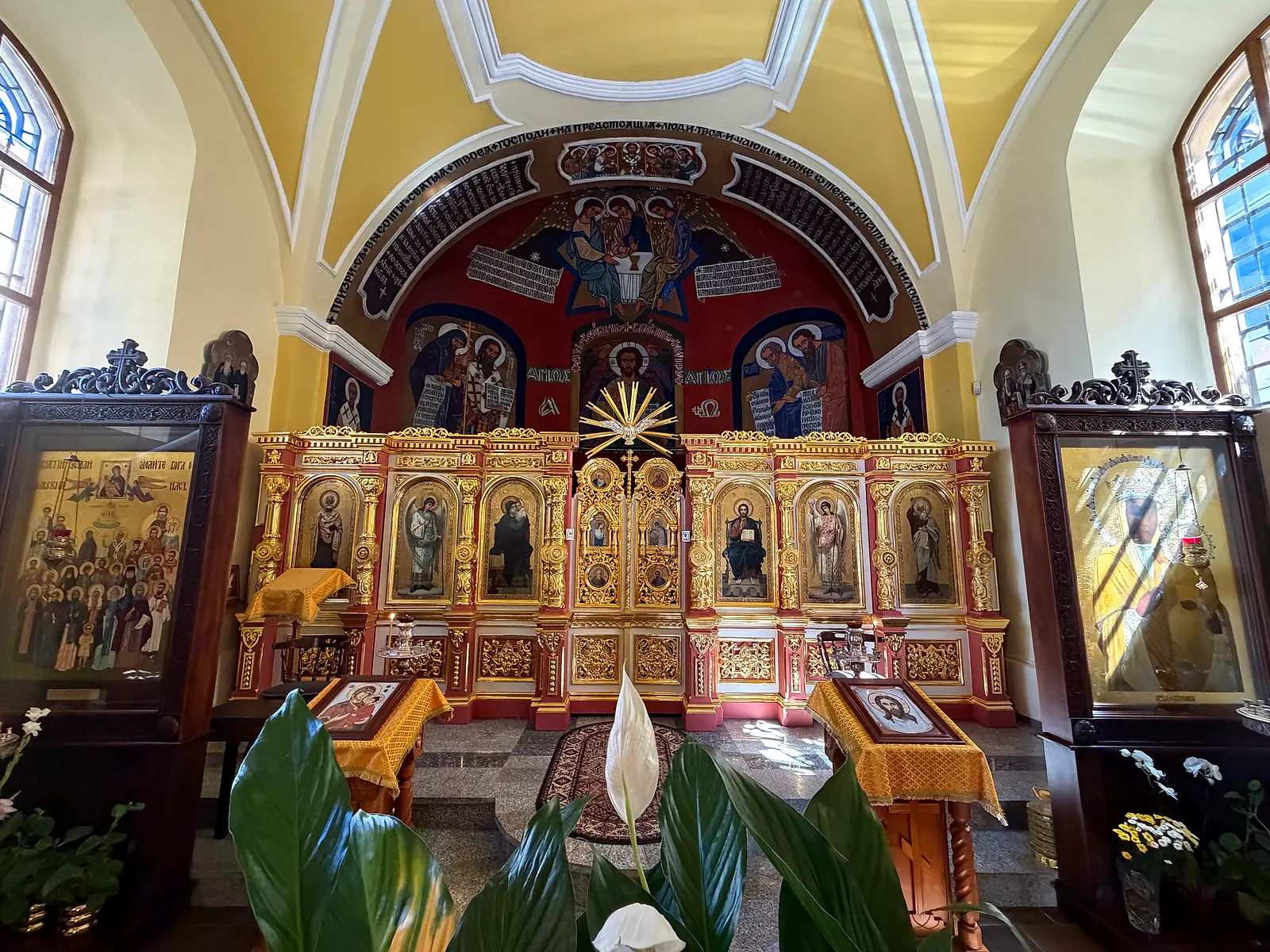
This building has had three lives. First a medieval chapel of the Blessed Virgin Mary stood here, and fire took it. Then, on its foundations, an eighteenth-century Catholic church. And since 1948 an Orthodox church, filled with things brought from the far end of the country, together with the people who were resettled here.
The chapel that burned
In 1453 a chapel was first recorded here standing *extra muros civitas* – outside the town walls. It was dedicated to the Blessed Virgin Mary; the names of Peter and Paul appeared only five hundred years later, with Orthodoxy.
It lasted not quite two hundred years. In July 1634, during the Thirty Years’ War, Jelenia Góra was set on fire and burned almost completely – along with the chapel standing in front of the walls. The same fire consumed St Anne’s Chapel at the Wojanowska Gate and the tower of the town hall.
Afterwards a new line of fortifications was run nearby and – as the parish records it – material from the ruins of the church went into building them, among other things. No scholarly study confirms that particular detail; let it stand as a tradition of the place rather than a fact.
The church of 1738
A century later the site came back into use. Work on the new Baroque church was completed in 1737 and it was consecrated a year later. It stands on the foundations of the burned chapel, and its builder was Caspar Jentsch.
That name has already come up on this route – and the story behind it is nicer than it might seem. St Anne’s Chapel at the Wojanowska Gate burned in the same fire of 1634 as the chapel that stood here. Both were rebuilt by the same man: Jentsch raised St Anne’s Chapel in 1709–1715, and this church a quarter of a century later. Two stops on the route, one fire, one builder.
The church served Catholics until 1925.
Twenty-three years without a faith
Then came an episode easy to forget, which explains everything now inside.
In 1925 the building was taken over by the town. The Baroque furnishings were dispersed to other churches, and the interior became an exhibition hall and then a museum of militaria. For over twenty years this was not a place of worship at all.
When the Orthodox parish received it in 1948, it received an empty shell. And that is why everything here today had to come from somewhere else.
How it became an Orthodox church
The Orthodox parish was founded in November 1947 by Father Stefan Biegun – a pioneer of such parishes in the southern part of Lower Silesia, who founded nine of them. A year later it was given this building.
The reason was concrete. In 1947, under Operation Vistula, more than a hundred and forty thousand people were forcibly resettled in the western territories – Ukrainians and Lemkos, including some thirty thousand Lemkos. Orthodox believers had appeared in Lower Silesia as early as 1945, with repatriates from the east, but it was Operation Vistula that created a community here large enough to need a church of its own.
Over the next four years the furnishings were assembled. Icons and liturgical objects were brought from destroyed churches in the Chełm and Lublin regions – not abandoned ones, destroyed ones; most of those buildings were simply pulled down. The iconostasis itself came from Hrubieszów, brought on Father Biegun’s initiative.
The first liturgy is dated by the sources to 1953.
In other words, the interior of this church was not made in Jelenia Góra. It arrived here exactly as the parishioners did – from more than five hundred kilometres away, and not by choice.
A Baroque church that had to learn Orthodoxy
It is worth pausing on what actually happened in 1948, because it was not a simple handing over of keys.
A Latin church and an Orthodox one are two different arrangements of space. An eighteenth-century Catholic church draws the eye straight to the altar – everything is meant to be visible. Orthodox liturgy requires the opposite: a wall of icons separating the nave from the sanctuary. An iconostasis is not an ornament but a boundary.
So a wall was put up inside a Baroque, single-nave interior. Brought from Hrubieszów, built for an entirely different building more than five hundred kilometres away.
What is worth seeing
- The frescoes of Jerzy Nowosielski and Adam Stalony-Dobrzański – the painting of the sanctuary, with Christ Pantocrator and the four Evangelists. Nowosielski is one of the most important Polish painters of the twentieth century. This is the kind of work people travel half the country for, and it is in a side church by the pedestrian street.
- The iconostasis from Hrubieszów – the main element of the interior and at the same time its biography.
- Two medieval stone crosses set into the northern wall, one carved with a crossbow and a sword. In Lower Silesia such crosses are called penitential: in the late Middle Ages a killer would found one as part of a settlement with the victim’s family, and the weapon was sometimes carved on it. Not every old stone cross is penitential, though – and for these two there is no document. But you can see them from the pavement, without going inside.
- The Baroque exterior, plain and single-naved: from outside this is a Silesian church and pretends to be nothing else. Inside it holds about a hundred people.
The church is listed as a monument under number A/4954/715, by a decision of 1960.
The parish today
This is a working Orthodox parish of the Wrocław and Szczecin diocese. It is not a monument to be toured between nine and five, but a church in which people pray every Sunday.
For a visitor that means one thing: we are guests here. The easiest way to see the interior is during a service – Sunday at ten, Saturday at five – but it is worth checking with the parish, because the Orthodox calendar differs from the Catholic one and feasts fall on other days. And one more thing: in an Orthodox church you usually stand rather than sit.
What else is nearby
The church stands on ul. 1 Maja, in the former suburb – outside the line of the walls, where the burned chapel stood. A few minutes away is the Wojanowska Gate with St Anne’s Chapel, rebuilt by the same builder, and in the other direction, along the same street, the Church of Grace, the next stop on the route.
The nearest stag is Karruś, a hundred metres away towards the old town.
Frequently asked questions
Is there an Orthodox church in Jelenia Góra? Yes, at ul. 1 Maja 40. It is the parish of the Holy Apostles Peter and Paul, active since 1947.
Was the building put up as an Orthodox church? No. It is a Baroque Catholic church, completed in 1737 and consecrated a year later, handed over to the Orthodox Church in 1948.
What is worth seeing in it? Above all the frescoes by Jerzy Nowosielski and Adam Stalony-Dobrzański in the sanctuary, and the iconostasis brought from Hrubieszów. From outside – two medieval stone crosses set into the northern wall.
Where does the iconostasis come from? From Hrubieszów. The furnishings were assembled between 1948 and 1952 from destroyed churches in the Chełm and Lublin regions, together with the population resettled under Operation Vistula.
What was here before? A chapel of the Blessed Virgin Mary, recorded in 1453 and burned in the town fire of 1634. The present church stands on its foundations.
Who built the present church? Caspar Jentsch – the same man who, after the fire of 1634, rebuilt St Anne’s Chapel at the Wojanowska Gate.
Can you go inside? It is a working parish church. Most reliably during services: Sundays at ten, Saturdays at five.
