 Szlak Jelonków
Krzywousty Hill and the Grzybek tower
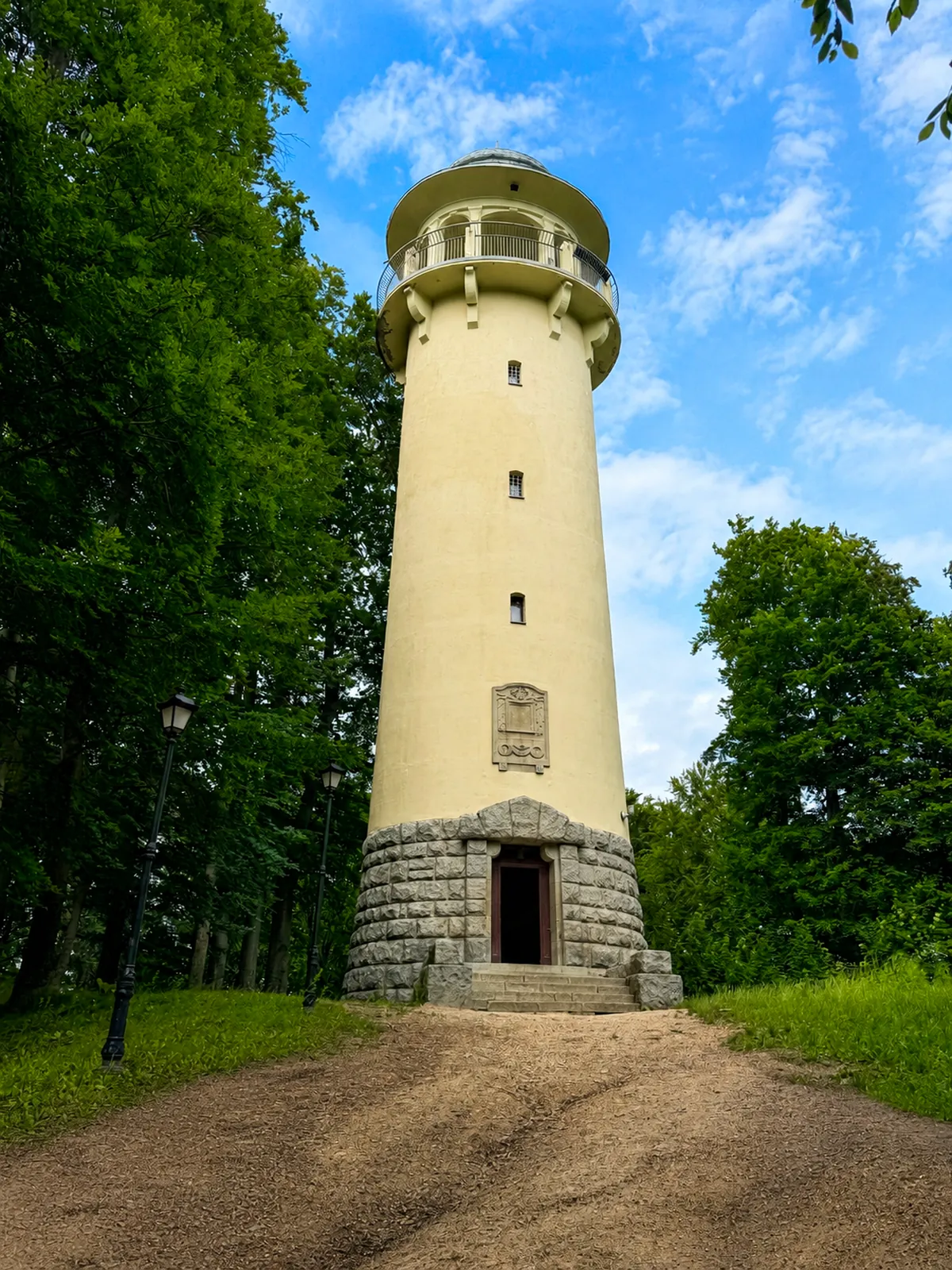
The best-known viewpoint of Jelenia Góra is the tower on Krzywousty Hill (375 m), popularly called Grzybek (“little mushroom”) – after the characteristic shape of its metal cap. From the terrace atop the 22-metre tower opens a panorama of the Karkonosze, the Rudawy Janowickie and the Kaczawskie Mountains, with the old town of Jelenia Góra at the foot of the hill.
The Kaiser Tower, or Grzybek
The tower was built in 1911 by P. Conrad – for the 800th anniversary of Jelenia Góra, counted from the legendary founding of the city by Duke Bolesław the Wrymouth. It was originally named the Kaiser Tower (Kaiserturm). An internal spiral staircase leads to the open viewing terrace; a restaurant with a terrace once operated at the foot of the building, of which no trace remains today. After renovation in 2009 the tower received a new metal cap – and it is to this cap that it owes its popular name.
The legendary castle of Bolesław the Wrymouth
The hill above the confluence of the Kamienna and the Bóbr is regarded as the legendary cradle of the city – its German name Hausberg simply meant “home mountain”. According to the most popular legend it was here that Duke Bolesław the Wrymouth raised the stronghold from which Jelenia Góra began – you will find that tale among the legends.
A defensive structure really did stand here: the remains of a medieval earthen rampart, about 150 metres long and up to 4 metres high, are still legible – though archaeology confirms nothing older than the 13th century. The castle was besieged during the Hussite Wars, and in 1433 the townspeople of Jelenia Góra obtained permission to demolish it. The ruins were still visible at the end of the 18th century, when a romantic park was laid out above the Borowy Jar gorge. Another version of the legend moves the city's oldest stronghold to Zamkowa Góra between the Paulinum palace and the Łomnickie estate – and links it with Bolesław the Brave, pushing the beginnings back to the 11th century.
How to get to Krzywousty Hill
The hill rises above the Bóbr on the western edge of the city centre – from the Town Hall Square you can reach it along park paths in about 20 minutes. It is worth extending the walk: behind the hill begins Borowy Jar, a picturesque gorge of the Bóbr leading to Jezioro Modre lake and the historic Perła Zachodu inn.
The green Trail of Piast Castles
Krzywousty Hill lies on the green-marked Trail of Piast Castles – one of the most interesting long-distance routes of Lower Silesia. Over about 150 kilometres, from Grodno Castle in Zagórze Śląskie to Grodziec Castle in the Kaczawskie Foothills, it links over a dozen Piast strongholds – including Książ, Bolków, Bolczów hidden among the rocks of the Rudawy Janowickie, and the ruins of Sokolec below Krzyżna Góra.
The hill with the legendary stronghold of the Wrymouth is the trail's natural stop within Jelenia Góra. From here the green marks lead through Borowy Jar past Perła Zachodu to the ducal tower in Siedlęcin – famous for its 14th-century wall paintings of the legend of Sir Lancelot – and to the castle ruins in Wleń, one of the oldest castellanies in Silesia.
Panorama from the tower
 Loading panorama…
 Drag to look around; scroll to zoom. The visible peaks and places are labelled on the panorama.
Full list of visible features (text)
Mountain ranges
Rudawy Janowickie · Karkonosze
Peaks and mountain sites
- Sokolik
- Krzyżna Góra
- Skalnik 945 m n.p.m.
- Ostra Mała
- Bobrzak
- Wzgórze Wandy
- Wzgórze Kościuszki
- Rudnik
- Przełęcz Kowarska
- Wołowa Góra
- Przełęcz Okraj
- Czoło
- Kowarski Grzbiet
- Skalny Stół
- Sowia Przełęcz
- Czarna Kopa
- Czarny Grzbiet
- Grabowiec
- Śnieżka 1603 m n.p.m.
- Kopa
- Czoło
- Grodna
- Studniční hora
- Schronisko Strzecha Akademicka
- Kocioł Małego Stawu
- Kocioł Wielkiego Stawu
- Smogornia
- Tępy Szczyt
- Sołtysia
- Mały Szyszak
- Schronisko Odrodzenie
- Przełęcz Karkonoska
- Przełęcz Dołek
- Śląskie Kamienie
- Czeskie Kamienie
- Żar
- Zamek Chojnik
- Śmielec
- Wielki Szyszak 1509 m n.p.m.
- RTON Śnieżne Kotły
- Łabski Szczyt
- Mokra Przełęcz
- Szrenica 1362 m n.p.m.
Places in the city
- Kościół pw. św. Krzyża
- Kościół pw. św. św. Erazma i Pankracego
- Ratusz
- Wieża Zamkowa
- Baszta Grodzka
- Cieplice Śląskie-Zdrój
- Sobieszów
What you can see from the Grzybek tower
The finest view opens to the south and east: the main ridge of the Karkonosze with Mount Śnieżka (1603 m), the Rudawy Janowickie with Skalnik, Sokolik and Krzyżna Góra, and part of the southern ridge of the Kaczawskie Mountains. Closer by you can admire the city, with the townhouses of the old town clearly visible.
Frequently asked questions
Where does the name Grzybek come from?
From the characteristic mushroom-like shape of the metal cap crowning the tower, renovated in 2009 (“grzybek" means ”little mushroom"). Officially it is the tower on Krzywousty Hill, formerly the Kaiser Tower (Kaiserturm).
When was the tower on Krzywousty Hill built?
In 1911, for the 800th anniversary of Jelenia Góra. It was built by P. Conrad on the site of the legendary castle of Duke Bolesław the Wrymouth. The tower is 22 metres tall, and an internal spiral staircase leads to the viewing terrace.
Was there really a castle on Krzywousty Hill?
A defensive structure did exist – remains of a medieval earthen rampart about 150 m long and up to 4 m high survive. However, no traces older than the 13th century have been found. The castle was besieged during the Hussite Wars, and in 1433 the townspeople obtained permission to demolish it.
What can you see from the Grzybek tower?
The finest view opens to the south and east: the panorama of the Karkonosze, the Rudawy Janowickie and part of the southern ridge of the Kaczawskie Mountains, and closer by – the townhouses of the Jelenia Góra old town.
Which hiking trail passes over Krzywousty Hill?
The green Trail of Piast Castles – about 150 km from Grodno Castle in Zagórze Śląskie to Grodziec Castle in the Kaczawskie Foothills. From the hill it leads through the Borowy Jar gorge past Perła Zachodu to the ducal tower in Siedlęcin and on to Wleń.
