 Szlak Jelonków
Jelenia Góra Town Trail · the long route · Cieplice
The Long House
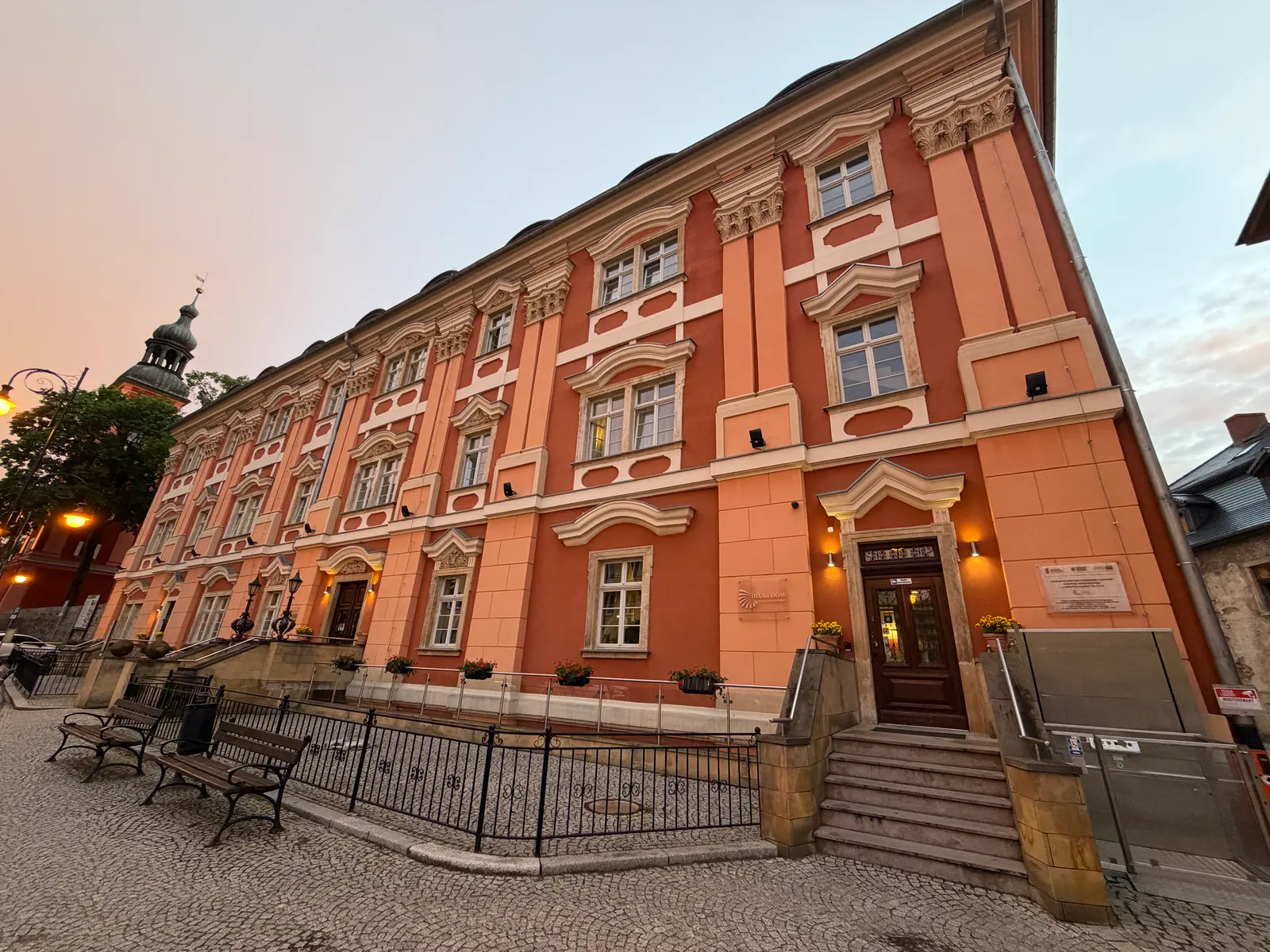
This elongated building on Plac Piastowski has a pedigree going back to the thirteenth century, and for most of its history it did exactly what it does now: it took in spa guests. Only not just any guests. The wealthiest stayed here, and so that they would not have to cross a yard on their way to the waters, a wooden, enclosed footbridge was run from the house to the pool. When even that stopped being enough, bathtubs were installed for them.
A house older than the spa we know
The Long House was most probably built in the thirteenth century, and its successive keepers were Augustinians, Knights Hospitaller, Protestant monks and Cistercians. It was originally a timber structure, and from the start it served visitors coming to the Cieplice waters.
That list of orders is the history of Silesia in miniature: owners changed, denominations changed, and the building went on doing its job. It would be hard to find a better example of continuity of function through a complete change of political surroundings.
The fire of 1671 and a new shape
The timber building burned down in 1671. It was rebuilt in its present form and became – as its current owner puts it – the finest building in Cieplice. The extension took place in 1689–1693.
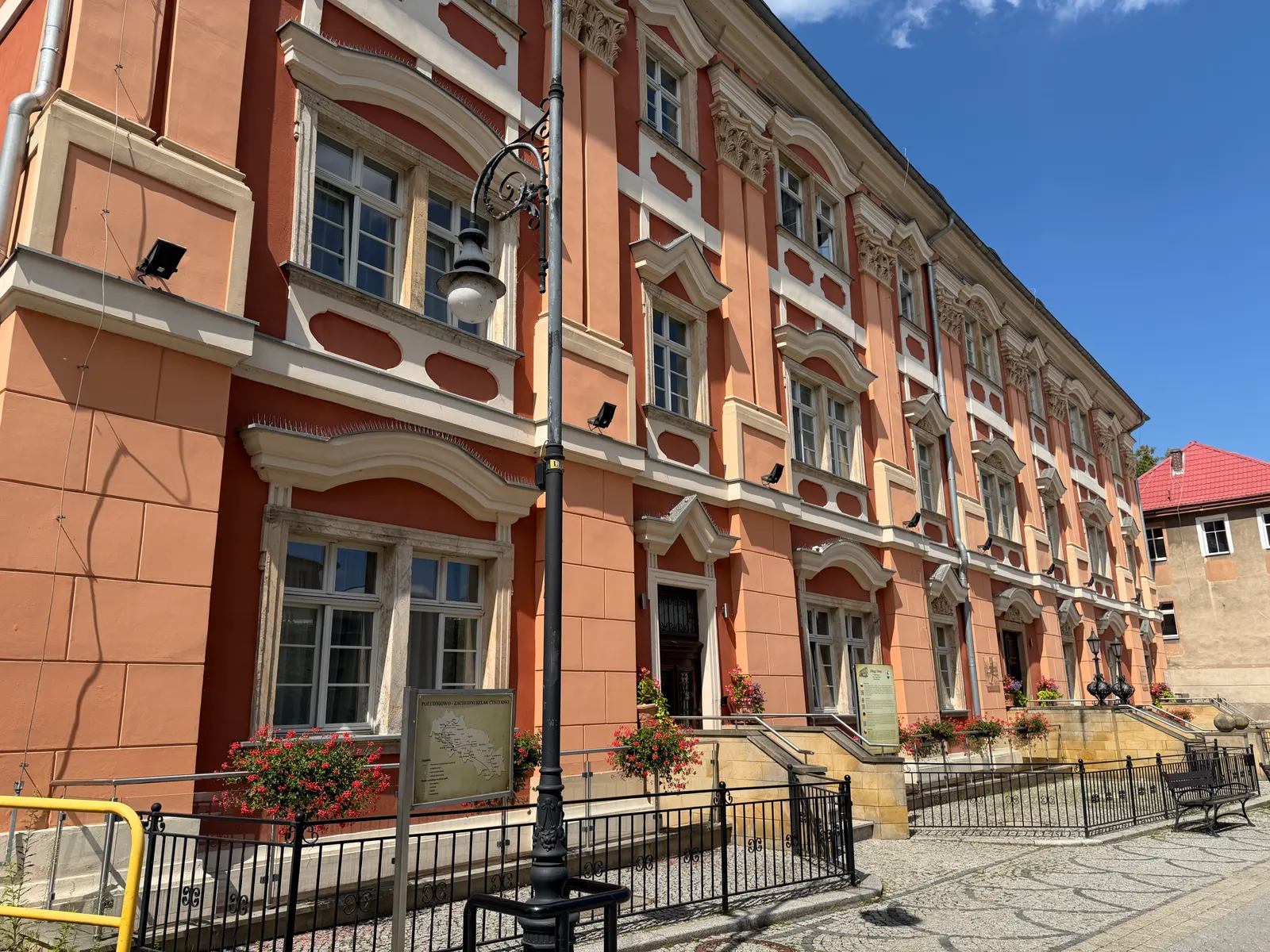
That work is attributed to the architect Martin Urban of Lubawka, acting on the initiative of Bernard Rosa, abbot of Krzeszów. The result is a compact three-storey block on an elongated rectangular plan – hence the name – shaped like an elegant town palace. Standing opposite, what you see first is the length and the rhythm of the windows; the building does not climb, it stretches sideways.
A footbridge to the pool, or eighteenth-century comfort
Only particularly wealthy spa guests lodged in the Long House – which explains a solution that today sounds like a five-star hotel: a wooden, enclosed footbridge led from the building to the pool. The guest walked to the waters under a roof, mixing neither with the rest of the spa nor with the weather.
In 1809 they went a step further: bathtubs for individual bathing were installed, because wealthy clients did not want to bathe in the pool in the company of all the other guests. That single sentence says more about the Cieplice of the day than many a description of architecture – bathing was then a communal matter, and privacy was becoming a commodity.
1810: the end of the Cistercians, the start of the Schaffgotsches
The year 1810 brought the secularisation of the monastic orders, after which the Cistercians lost their property. The building was bought and renovated by Count Leopold Gothard Schaffgotsch. At the same time the family was taking over the surrounding former monastic estates, so the Long House was part of a larger operation: church property passing into the secular hands of a single family.
When the house stopped healing and started showing
In the middle of the nineteenth century the building ceased to serve therapeutic purposes. Instead of guests, collections moved in: the natural history collection was brought here and a museum display was created. From the Schaffgotsch Palace came the library, the coins and the prints as well, and from the 1830s the whole was open to visitors.
In 1876 the natural history collection was enlarged by the ornithological collection of Doctor Luchs, a local physician – combined with the count's holdings it was reckoned the largest private collection of its kind in Europe. Hence the label that stuck to the building for decades: “the bird museum”.
Museum, offices, spa guests again
After 1945 the Long House became the property of the Cieplice spa company. The museum worked here until 1965. Then, until 2014, the building housed offices – the period in which the oldest house of the spa disappeared from tourists' view.
The collections had dispersed earlier. In the 1960s they were parcelled out among cultural institutions across the country, and in 1967 the reduced natural history part went to the Norwegian Pavilion, giving rise to the Natural History Museum in Jelenia Góra. Today you will see it in the former Cistercian monastery at ul. Cieplicka 11A – a few dozen metres from here.
The Long House itself has returned to its oldest role: it serves spa guests again. It has rooms, a restaurant and a treatment centre. After seven centuries the building is doing what it started with.
A walk in the tracks of one collection
The collections that stood in this building for a hundred years scattered across the city and the country – but the three addresses they moved between lie side by side here and can be walked in a quarter of an hour. It is probably the most interesting way to cover this stretch of the trail.
The Schaffgotsch Palace – the starting point. From there, after secularisation, the library, the coins, the prints and the natural history collection went to the Long House. The Long House – where they stood longest and where the museum worked, until 1965. The Norwegian Pavilion in the Spa Park – where the reduced natural history part went in 1967 and where the Natural History Museum began. The Cistercian monastery on ul. Cieplicka – today's seat of the museum, that is, where those same specimens stand now.
The whole loop is less than a kilometre and shows something no single building can: a collection two hundred years in the making went through four moves after the war and came back to an address next door to the one it started from.
What you can see
The building is part of a working spa, not a museum – you can look at it from outside at any time, while the interiors are for hotel or restaurant guests. It is worth stepping into the courtyard between the Long House and the Natural History Museum: it is open to all, and from there you see both blocks at once – the house where the collections stood, and the monastery where they stand today.
Photographs
Frequently asked questions
Was there a bird museum in the Long House?
Yes. The natural history collections, including the famous ornithological one, were moved here in the middle of the nineteenth century, and the museum worked until 1965. The collections were then dispersed, and the natural history part went in 1967 to the Norwegian Pavilion, giving rise to today's Natural History Museum.
How old is this building?
Its pedigree probably reaches the thirteenth century, but the present shape comes from the rebuilding after the fire of 1671 and the extension of 1689–1693.
Where does the name come from?
From the plan: the building was raised on an elongated rectangle.
What was the footbridge to the pool?
A wooden, enclosed passage leading from the Long House straight to the pool, so that wealthy spa guests did not have to step outside.
Can I go inside?
It is a working spa building with rooms, a restaurant and a treatment centre, so the interiors are open to guests.
