 Szlak Jelonków
The legend of cruel Kunigunde of Chojnik Castle
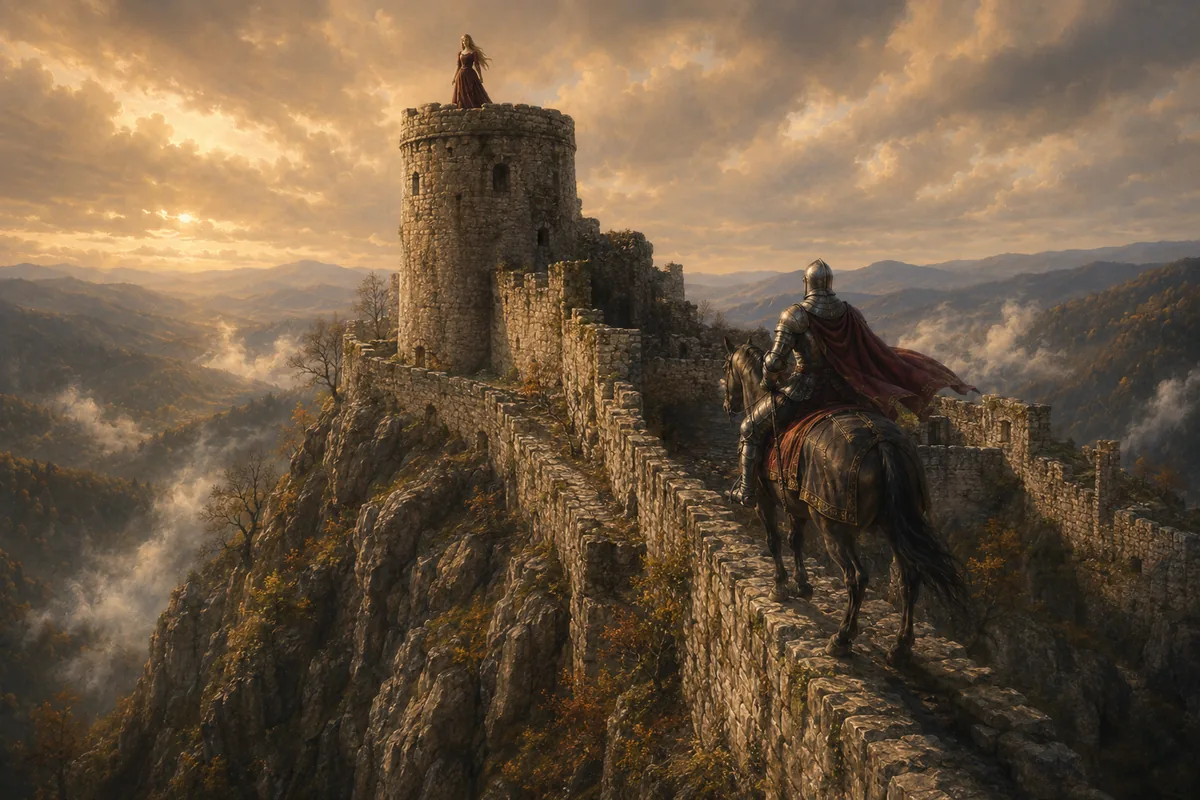
High above the valley, on the summit of a steep, forested mountain, the castle of Chojnik – Kynast in German – has stood for centuries. Its walls rise straight from the rock, and on the south-east they drop in a cliff a hundred and fifty metres deep, into a chasm people named the Hell Valley. It was here that the most famous of all the Karkonosze legends played out – the tale of beautiful, cruel Kunigunde.
They say the lady of Chojnik was the most beautiful girl in the whole duchy. Her hair was like flax, her eyes like mountain lakes, and her bearing so proud that many a knight lost his head at the mere sight of her. Suitors came from distant lands – great lords, knights covered in glory, young men with burning hearts. To each Kunigunde smiled sweetly, and to each she set the same condition.
"I will marry the man," she would say, "who in full armour, upon his steed, rides all the way around the walls of my castle. Whoever circles them and returns to the gate shall have my hand and all the land of Chojnik."
It sounded like a game for a bold rider. But whoever climbed to the top and looked down turned pale. The wall ran along the very edge of the rock, narrow as a footpath, and on one side gaped a bottomless abyss. One stumble of a horse, one stone slipping beneath a hoof – and the rider fell into the Hell Valley, from which no one returned.
And yet they tried. One after another they rode onto the wall, driven by love or by pride, and one after another they perished in the chasm. Kunigunde watched from the tower without a single tear, without a flicker of her face – as if the death of brave men were merely a spectacle staged for her amusement. In the valley they spoke of her with dread: her heart is of stone, harder than the rock her castle stands upon.
Then one day there came to Chojnik a knight such as had never been seen there – calm, sure of himself, with a clear gaze. He heard the condition, nodded, and without a word mounted his horse. The whole castle held its breath. The knight rode onto the wall and set off along the edge of the abyss – slowly, evenly, as though riding a broad road. Hooves rang on the stone, the wind tore at his cloak, and he circled the tower, passed the most terrible bend above the cliff, and calmly rode back down to the gate. He had done the impossible.
Kunigunde sprang up, triumphant, and reached out her hands to him – at last the one worthy of her had been found. But the knight did not dismount. He looked at her coldly and spoke so that all could hear:
"So many brave men died here for your vanity, and you watched their death with a smile. I want neither you nor your castle. Your heart is worse than that abyss."
With that he turned his horse and rode away without looking back. Kunigunde was left alone – humiliated for the first time in her life, before the whole court. They say she could not bear it: she ran onto the wall, to the very place above the abyss where so many knights had died, and threw herself into the Hell Valley. So ended the cruel lady of Chojnik.
And the castle still stands. When you stand on its walls and look into the abyss, it is easy to believe that the wind whistling here among the stones is still the echo of that old, stony pride.
Frequently asked questions
What is the legend of Chojnik Castle?
It tells of the beautiful, cruel princess Kunigunde, who would marry only the man who could ride in armour around the castle walls above the precipice. Many knights died; when one finally succeeded he refused her hand, outraged by her cruelty, and the humiliated Kunigunde threw herself into the Hell Valley.
Did Kunigunde really exist?
No – she is a legendary figure, absent from the historical record. What is real is Chojnik Castle itself and its roughly 150-metre cliff above the Hell Valley, which became the setting of the tale.
Where is Chojnik Castle?
On the summit of Chojnik mountain (627 m) above Sobieszów, a district of Jelenia Góra in the Karkonosze. Today it is a ruin with a PTTK shelter and a viewpoint.
